
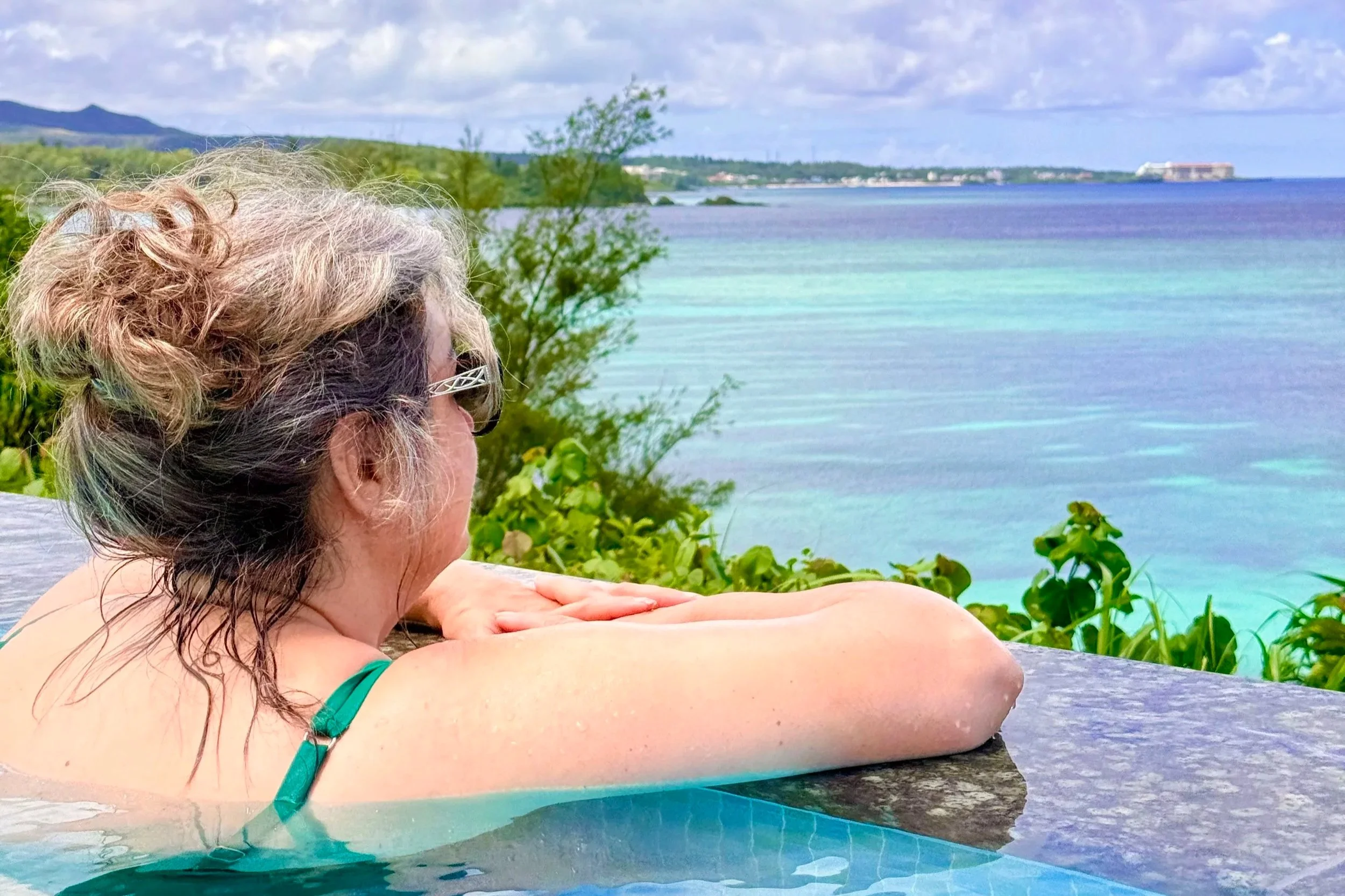
With the East China Sea below the infinity edge, there was nowhere else we needed to be.
The bar at Sunset Bar SPECTRA is built at table height. Not a long counter with one lowered notch cut into the end, the whole thing, and the bartenders work in a well sunk below it so they stand at eye level with whoever is sitting there. We have spent a lot of evenings in hotel bars. This was the first one where a wheelchair user pulls up and is simply in the conversation instead of beside it.
We came home talking about that bar, and it is a fair introduction to this resort, which gets a few things right that almost nobody gets right and misses a couple that are easier.
Five nights in August, in an accessible Ocean View King in the Sunset Wing, at the end of three weeks that had already run through Hong Kong and Taipei. The resort sits on the west coast of Okinawa's main island, in Onna, facing the East China Sea, which means it faces the sunset. It holds two Michelin Keys, the only hotel on Okinawa's main island that does. It is also the priciest address on the island.
Okinawa gets called the Hawaii of Japan and five minutes on the coast road explains why, so a Hawaiian hotel brand opening here reads as almost too neat an idea. What happens inside is more interesting than the idea. This is a Japanese resort with a Hawaiian name and a light Hawaiian accent, and the people around the pool were overwhelmingly Japanese families on vacation. We have never stayed at the original in Waikiki. After five nights here we feel like we have to, just to see which way the influence actually runs.
The Room
The first thing we noticed was the floor. Wide oak planks wall to wall, with a rug you roll across instead of fight. Carpet is the standard in resort rooms at this level, and it is the standard because nobody pushing a chair across it gets a vote.
The room runs in cream and pale wood and there is a great deal of it. The bed on one side, a sofa and a round table opposite, and between them open floor rather than a corridor. The bed sat at a good height for transfers, which is as often luck as design. We never once had to plan a turn.
The bathroom is where the room stops being merely comfortable and starts being unusual. It is enormous, laid out as a wet room, with a level tiled floor running straight into the shower and no curb anywhere to stop a chair. There is a rainfall head overhead and a handheld on a slide bar, which is the pairing that actually gets used. A deep soaking tub sits under its own window with the blinds half open to the water. The toilet is a Toto with a proper assist rail beside it.
Floor-to-ceiling glass runs the length of the balcony wall under wooden blinds, so the room fills with light through the afternoon and the water is there every time you look up. Waiting on the table when we walked in were two small sweets under glass domes, which is the sort of arrival gift that usually photographs better than it eats. These were good.
The balcony runs the width of the room, a table and two chairs at one end, a lounger at the other, and it is where we spent the start and the end of every day. The water sits directly in front of it. Late in the afternoon the sun comes down the sliding glass and lands on the floor inside, and there is no decision to make about where to sit.
The detail we kept talking about came at turndown. Pajamas, laid out on the bed, folded, a set each, every night. Not a chocolate and a weather card. It is a Japanese hotel convention more than a Halekulani one, and it was the small thing that told us where we actually were.
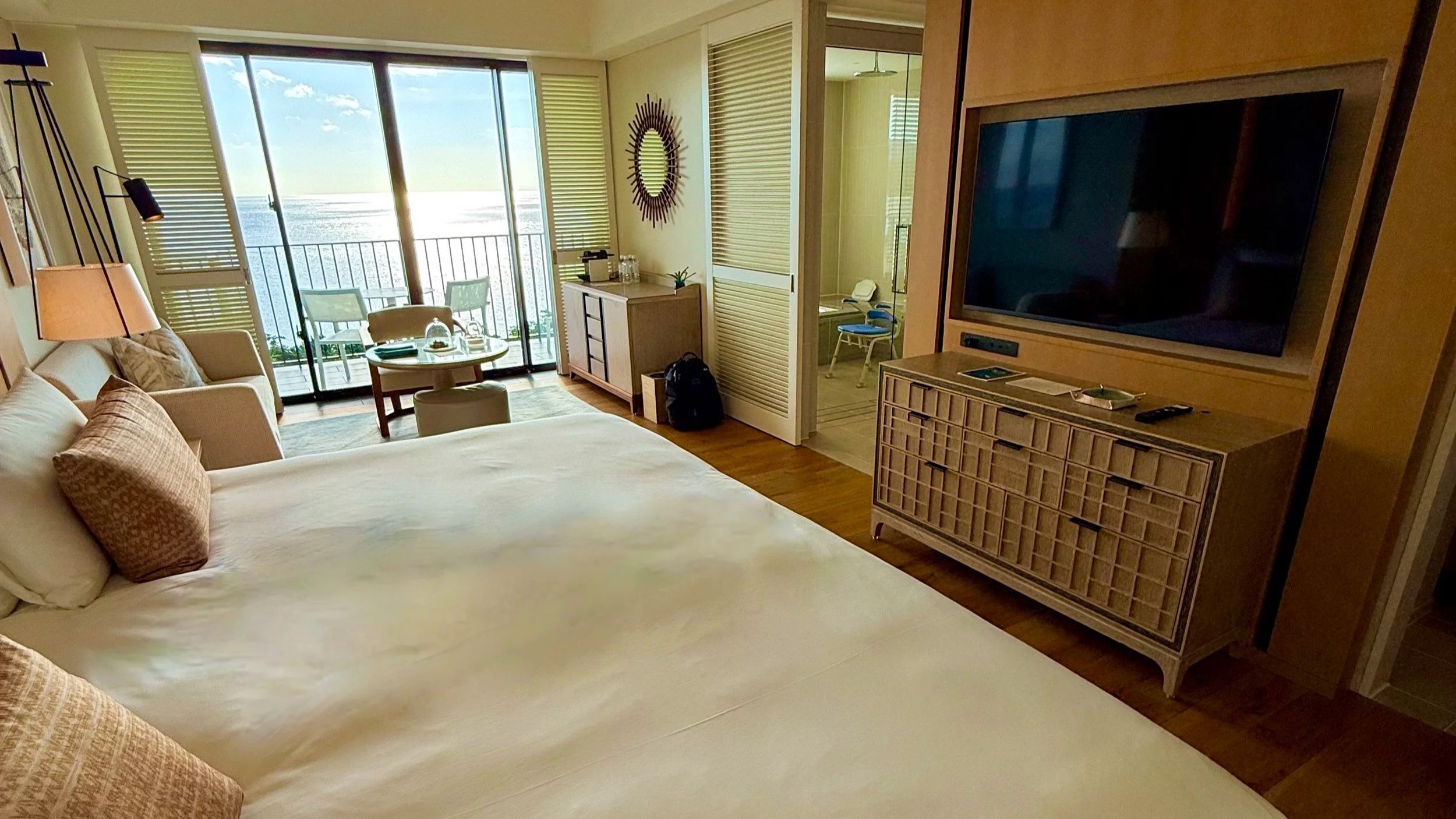
Our accessible Ocean View King had wood floors from the door to the balcony and the shower chair already set up in the bathroom.
The Dining Scene
This is the part of the stay we would change, and it is worth saying up front because it is the one real reservation we have. The food is good. There are not enough options, and there is very little within walking distance.
SHIROUX: We ate breakfast here several times and it is why we stopped bothering with the buffet. Not a buffet at all, ordered at the table, in the prettiest room in the hotel with the view doing half the work. The service was flawless in the way Japanese service is flawless, meaning you never once caught anyone doing it. The breakfasts were good. Nothing on them stood out.
House Without a Key: The main breakfast room, and a buffet, which is why we only came for breakfast once. It was good quality with a reasonable spread, and buffets are simply not our thing. Dinner is served from a menu, which is part of why it was the better meal, and we came back for it several times.
The name puzzled us all week. Halekulani means house befitting heaven in Hawaiian, and the restaurant takes its name from a 1925 Charlie Chan mystery of the same title. That title came from a Waikiki house that really did have no key, on a property the original Halekulani later took over.
Kingdom: Steak and seafood with a few other things, and the room to come to when you want a proper dinner rather than a view. We had the pork chops one night and they were excellent.
Kingdom is also where the most useful thing we can tell you about eating in Japan applies. Japanese beef is extraordinary and it is priced like it, which lands hard on Americans who are used to steak being the sensible order. The move is to eat what the place you are standing in actually produces. In Okinawa that means seafood and pork, both of which are just as good and cost a fraction of what the beef does.
Sunset Bar SPECTRA: We ended up here on several evenings. The bartenders take their time. Watching a drink get built in front of us, slowly, with somebody paying attention to each step, turned out to be half of what we were paying for, and the drinks were worth the wait on their own. The one we kept going back to arrived packed with fresh mango, real fruit cut into the glass rather than a purée poured from a bottle, a sprig of green on top and the sun dropping into the water directly behind it. We planned the end of several days around that hour.
The coconut cake is the thing to order anywhere on this property. Shredded coconut piled over a pale sponge that is barely sweet. We had it twice, and the second time we asked whether it could find us at the Sunset Bar rather than at a table. A few minutes later it did.
One honest adjustment. We came to Japan expecting Japanese food, the gyoza and the ramen we love, and Okinawa does not eat that way. The island has its own kitchen and it leans hard on pork. That makes complete sense in hindsight and we were still caught out by it, partly because we are not big pork eaters and had been counting on more seafood than we got. The Okinawan food is good on its own terms. It is not the food we packed our appetites for.
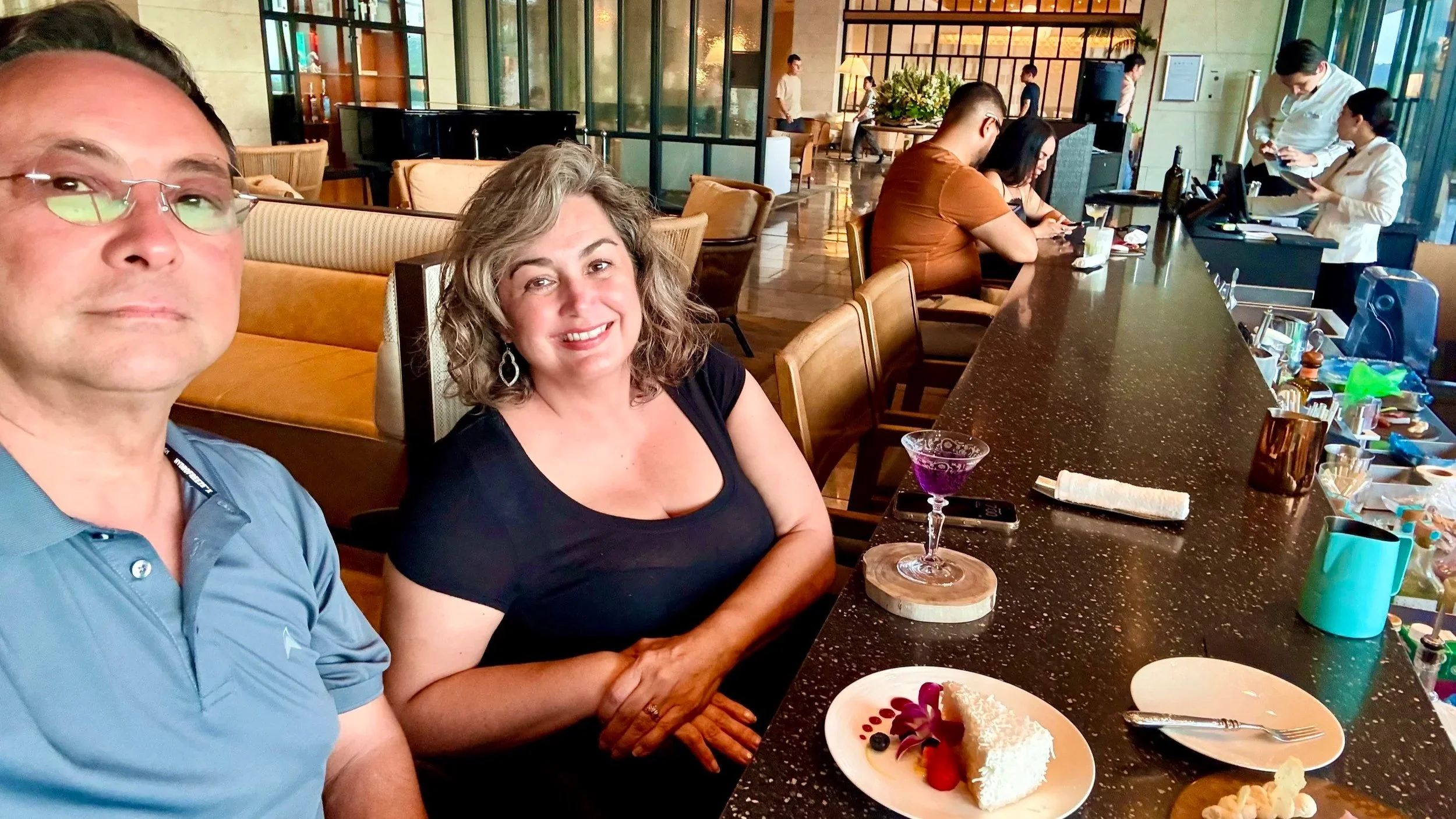
The coconut cake found us at the Sunset Bar SPECTRA, at a counter low enough that a wheelchair rolls right up.
Beyond the Room
The Sunset Pool: An infinity edge looking straight out at the water, on our side of the resort, restricted to guests sixteen and over. We spent most of our days here. The age limit does most of the work. It is quieter than the family side without anyone having to enforce quiet, and when the light goes in the late afternoon there is nowhere better on the property to be. We got into a rhythm by the second day of swimming, drying off, and then not moving again until somebody came by to ask whether we wanted another drink.
The Orchid Pool: The main pool, and the family one. It is big and round and ringed two deep in white umbrellas, and there is an orchid worked into the floor in mosaic tile that only reads properly from above, which means from a balcony rather than from the water. Every lounger around it had a towel on it by mid-morning. This is where the resort keeps its noise, and we were glad it had somewhere to keep it.
There is a third pool out above the beach, also with an infinity edge, and it was busy every time we passed it. All of them are beautiful. The choice is really about who you want to be swimming next to.
The Indoor Pool: There is an indoor pool, which we had never run into before at a resort in a tropical climate and did not expect. It is fed by the property's hot spring, which is the part that makes sense of it. An onsen is not a thing you give up because the weather is warm.
SpaHalekulani: The standout, and not by a small margin. One of us had a massage from a therapist from Hiroshima that goes straight into the top handful we have had anywhere in the world, and we say that as people whose benchmark for the last twenty years has been Thailand. The rooms are quiet in the way a spa is supposed to be quiet and almost never is. We came out of ours with no idea what time it was and no interest in finding out.
Our one complaint is where they put it. The spa sits at the far end of the property from our wing, which is the one with the age limit and the guests most likely to book a treatment. Putting the age-restricted pool at one end and the spa at the opposite one is a decision we still cannot explain.
The Club Lounge: We did not have access, so take this as an observation rather than a review. It sits just off our wing's lobby and we passed it several times a day. It never looked busy and never looked like much. Access comes with the suites, the villas and the Premier Club Ocean Front rooms, so buying in means moving up a category rather than paying a flat fee. If you are weighing that jump, we would want a closer look at the lounge before letting it decide the room.
Not having access cost us nothing we noticed. At a resort where the best seat is a stool at SPECTRA and the next best is your own balcony, we are not sure what the lounge is competing with.
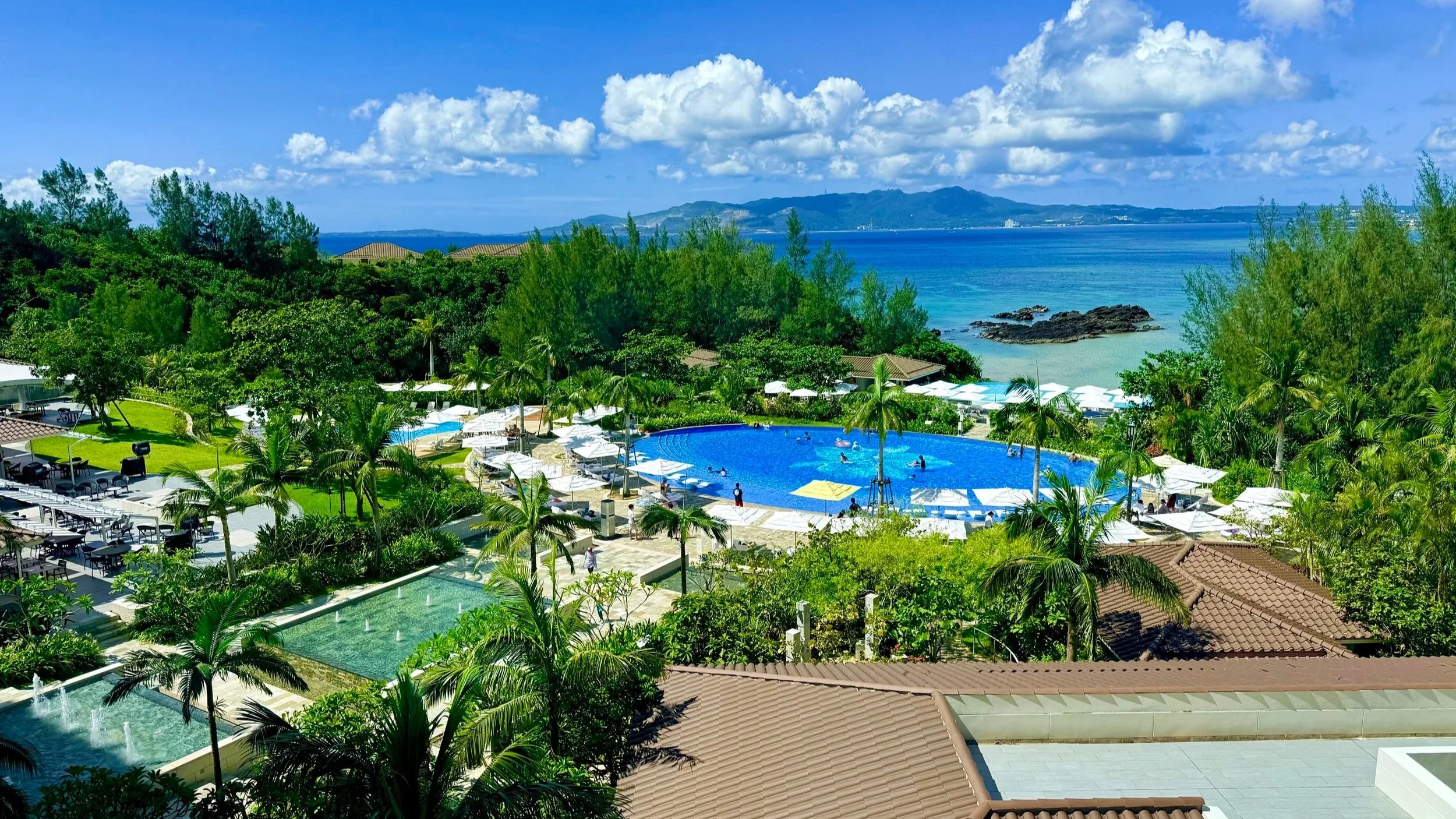
The orchid tiled into the floor of the Orchid Pool only reads from above, which makes this the one view of it that works.
The Experience
Brand: Halekulani arrives here as a Hawaiian name on a Japanese building, and the balance is better than that description suggests. The Hawaiian element is a light accent rather than a theme, and what you are actually staying in is an Okinawan resort. Those two Keys put it at the top of a field that includes a Ritz-Carlton and a Hoshinoya.
Ambiance: Peaceful, and the clientele is most of the reason. This reads as a place Japanese travelers come for vacation rather than a place built for foreign visitors, and the volume of the whole property sits lower because of it. The resort is big and shaped long rather than wide, with staff running golf carts between the ends. We walked it the entire time. It is more walkable than its own shuttle service suggests.
The views do the rest. Blue water on one side, green growing up over everything on the other, and the sun going down in front of you every evening because the building is pointed that way. We stopped taking photographs of it around day three, which is usually the sign that a view has stopped being a novelty and started being where you live.
Service: What you would expect in Japan, which is to say correct to a fault. The difference here is temperature. It was warmer and more openly friendly than Japanese luxury service usually runs, which suits an island where people have come to be on vacation rather than to be impressed.
Masae in the concierge team is the reason we would return. It started before we arrived, working out what we wanted to see and do, and it did not let up once. She saw us off most mornings as we left the property. She put umbrellas and cold drinks in the car for our drives. There was a gift waiting for us on our last night. The resort was full the entire stay and she gave no sign of handling anyone but us, which is a trick we have seen attempted far more often than we have seen it done. One of the guest services team did the same thing in a smaller way, finding us wherever we happened to be and greeting us every day as though we were the only people she had been waiting for.
Accessibility
This is one of the most completely accessible resorts we have stayed in, and the reason is boring and structural. There are ramps everywhere. Across five nights on a property this large we never found a single place we could not get to in a wheelchair, which we cannot say about most hotels half this size.
The room does the basics properly and then some. Hard floors rather than carpet. A bed at transfer height. A wet-room bathroom with a level floor into the shower, no curb anywhere, and a real grab bar at the toilet. Floor space measured in open room rather than in inches of clearance.
The shower has no fixed bench. The hotel brings a portable chair instead, which is the common answer across the industry and not a complaint, though a built-in bench is what we would ask any property to install.
The bar is the part we would like other hotels to copy. A bar at table height, with the working side dropped so the bartender is at eye level, costs nothing extra at the design stage and changes the entire evening for anyone who cannot perch on a stool. We have not seen it anywhere else.
The pools have no lifts. What they have instead is a raised lip around the edge, high enough to transfer onto and then down into the water, which works if you have the upper body to do it and does not if you do not. It is a better answer than most resorts outside the United States manage, and it is still not a lift.
Two gaps. There are no accessible golf carts, which is close to universal and no more forgivable for being common. We also never saw a beach wheelchair, which on close to a mile of sand is the one thing we would push them on.
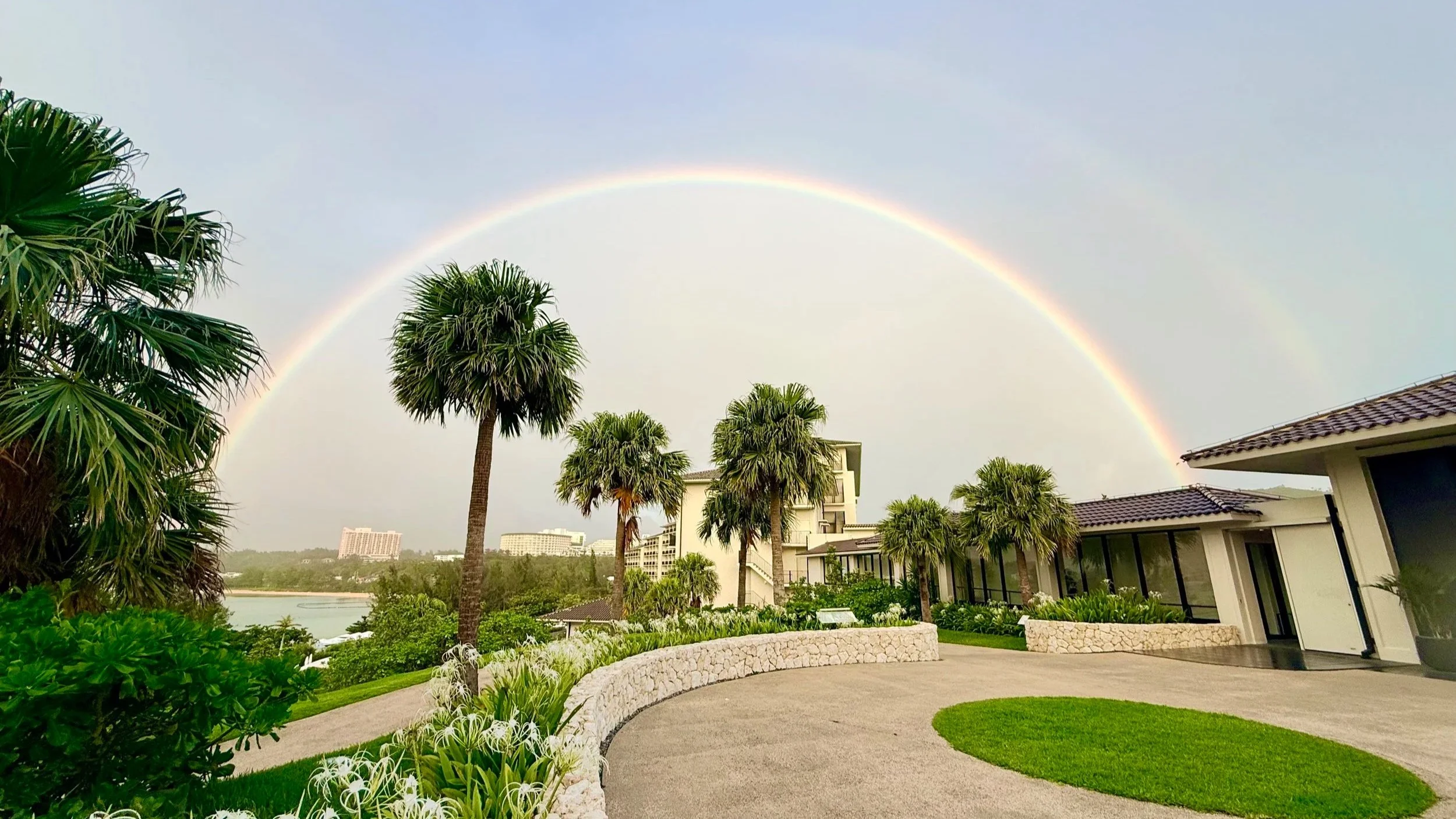
A rain shower moved through and left a double rainbow arched over the resort.
The TudorTravels Perspective
Halekulani Okinawa is for the traveler who loves Japan and wants a tropical version of it, and for anyone who loves Hawaii and would take the same beach with Japanese and Okinawan food and manners attached. It is also simply a very good luxury beach resort somewhere most Americans have not thought to look.
The thing to understand before booking is the location. The resort is not near anything. Okinawa does not have the public transportation you get on the mainland, so every outing means arranging a car, and there are only a handful of restaurants within a walking mile. If you are here to spend your days at Churaumi and the sites around the island, this is a beautiful base that will cost you an hour in the car each way. If you plan to stay put, none of that matters.
On value, this is the most expensive resort on the island and we think it earns the number. Not because of any single thing it has that the Ritz-Carlton down the coast does not, but because of how little friction there is in a stay here. We booked through Virtuoso for the amenities and would do that again.
We did get out. Masae arranged a private driver and an accessible vehicle, which is what makes the island reachable at all from here, and the island rewards the effort, from Churaumi down to the coast roads. That belongs in its own piece rather than this one, and we have written Okinawa up separately.
And we would go back, mostly for the people. The warmth is the thing we remember, more than the room or the pool or even the spa.
The one thing holding us back is the food, and that is as much about us as about the resort. Our top priority when we travel is eating, and the food experiences are what we build a trip around. For a resort at this price the menus were narrower than we are used to, and nothing close enough to walk to that would make up for it. If what you want is a relaxing luxury beach with a Japanese touch, this place is close to perfect. If you travel to eat, know that going in.
The Sunset Wing was the right call and we would book it again without thinking about it.
Ready to book Halekulai Okinawa, or planning a trip through Japan or Asia? Contact us to start planning.