
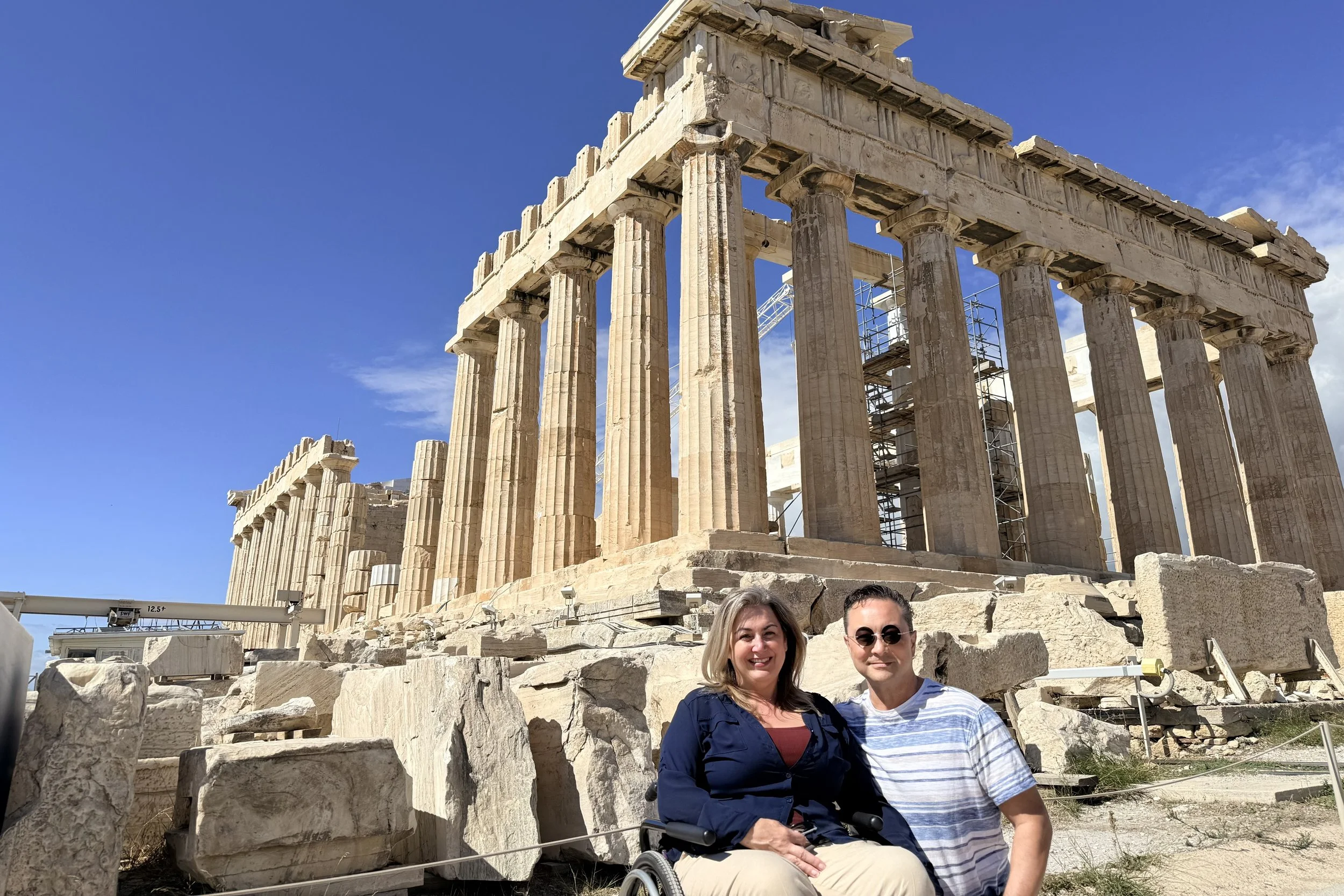
Still being restored after more than 40 years of work. It is extraordinary regardless.
Athens hits differently early in the morning. The Acropolis is the color of bone and the city below it is still quiet and you are standing there with good coffee from the bakehouse window at the hotel wondering how a thing that old can still manage to be a surprise. Glenn was a teenager with his family the first time he saw it and barely understood what he was looking at. The second time, we stood there together. We keep going back because Athens is one of those places that changes what it shows you depending on who you bring.
The city does not try to make it easy for you. The traffic is real. The heat in summer is not a guidebook warning, it is a fact that reorganizes your day around it. The signage is inconsistent and the sidewalks have opinions about where they go. None of that ends up mattering, because Athens has something that almost no other major European city has in the same quantity: people who will step in. The Greeks call it philoxenia. Love of the stranger. It is not a marketing concept here. It is what happens when a taverna owner spots Judy coming with her wheelchair and has already moved a table and chairs before we reach the door.
What you get in Athens, if you let it work on you, is a city that is completely itself in a way that most tourist destinations have given up trying to be. The Acropolis is there. So is the neighborhood beneath it where nothing about the afternoon has changed in thirty years. So is the Mastiha, which you will not expect and will not forget. Most people who visit Greece go straight to Santorini or Mykonos. We understand it. The islands are beautiful. But they are a completely different country from Athens, and the people who only ever see them do not know what they are missing. We did not know either, the first time. Now we cannot imagine going to Greece without it.
The Hotels
Staying in Athens used to be a compromise. You either stayed near the Acropolis in a dated room, or you stayed far away to find luxury. That has started to change. The city's hotel scene has exploded, offering everything from food-centric boutiques to Riviera-style resorts that rival anything in Italy.
Ergon House Athens: This place is a sanctuary for the culinary obsessed, and the moment you arrive you understand why. Located steps from Syntagma Square, the hotel sits directly on top of a large, modern market. You walk past hanging cured meats and shelves of artisanal olive oil just to get to the elevator. The energy is loud, aromatic, and cool in a way that no amount of lobby design could manufacture. The location puts you within walking distance of every major sight, but the real draw is downstairs. The ground floor market is the best place in the city to pick up gifts, particularly the small-batch honey and artisanal olive oils. Their sister property, Ergon Bakehouse, is just around the corner. We are not exaggerating about the spinach pies.
Book This: A lower-floor room. They are particularly well-designed with wide doorways and generous layouts, and the proximity to the market energy below makes the whole stay feel more connected to the neighborhood.
Accessibility: The lower-floor rooms feature wide doorways and open layouts that feel inclusive rather than clinically adapted. The building is modern with lift access throughout.
Four Seasons Astir Palace: If you want to feel like you have escaped to a private Greek island without leaving the mainland, this is the place. Perched on the Athens Riviera in Vouliagmeni, about 30 minutes from the city center, the Astir Palace is serious luxury. It is serene, exclusive, and quiet in the best way. The resort is divided into three distinct zones: Nafsika, which is the family-friendly area with its own pool; Arion, which is quieter and suited to couples; and the Bungalows, the most private of the three, tucked into their own secluded stretch of the peninsula. The flagship restaurant Pelagos holds a Michelin star and is worth a dinner even if you are staying elsewhere. One piece of advice we give everyone who asks: think of this as a vacation within a vacation. If your primary goal is daily sightseeing at the Acropolis, the 30-minute commute each way will get old quickly. Split your stay instead. Spend a few nights in the city center to cover the ruins, then move here for a few nights to do absolutely nothing.
Book This: A room or suite in the Arion wing. It is the quieter side of the resort, suited to couples, and the adults-only infinity pool on the spa level has some of the best sea views on the property.
Accessibility: Ramps and wide paved paths connect the restaurants, pools, and beaches throughout the resort, ensuring no part of the property feels off-limits to wheels or strollers.
Hotel Grande Bretagne: This is Athens royalty. Since 1874 this landmark has hosted heads of state, royalty, and honeymooners, and entering the lobby still feels like walking into a different century. The soaring columns, marble floors, and a staff that seems to know what you need before you ask establish the tone immediately. The hotel has modernized the important parts without losing any of the grandeur that makes it irreplaceable. High tea in the Winter Garden, with its rose-hued walls and stained-glass ceiling, is worth doing whether or not you are staying here, which is a rare thing to say about a hotel restaurant. And the GB Roof Garden, with its direct sightline to the Acropolis, is one of the great views in all of Athens.
Book This: An Acropolis-view room. Waking up to the Parthenon outside your window never stops being extraordinary.
Accessibility: Elevator access reaches all main areas of the hotel including the GB Roof Garden, meaning the Acropolis view is available to everyone regardless of mobility.
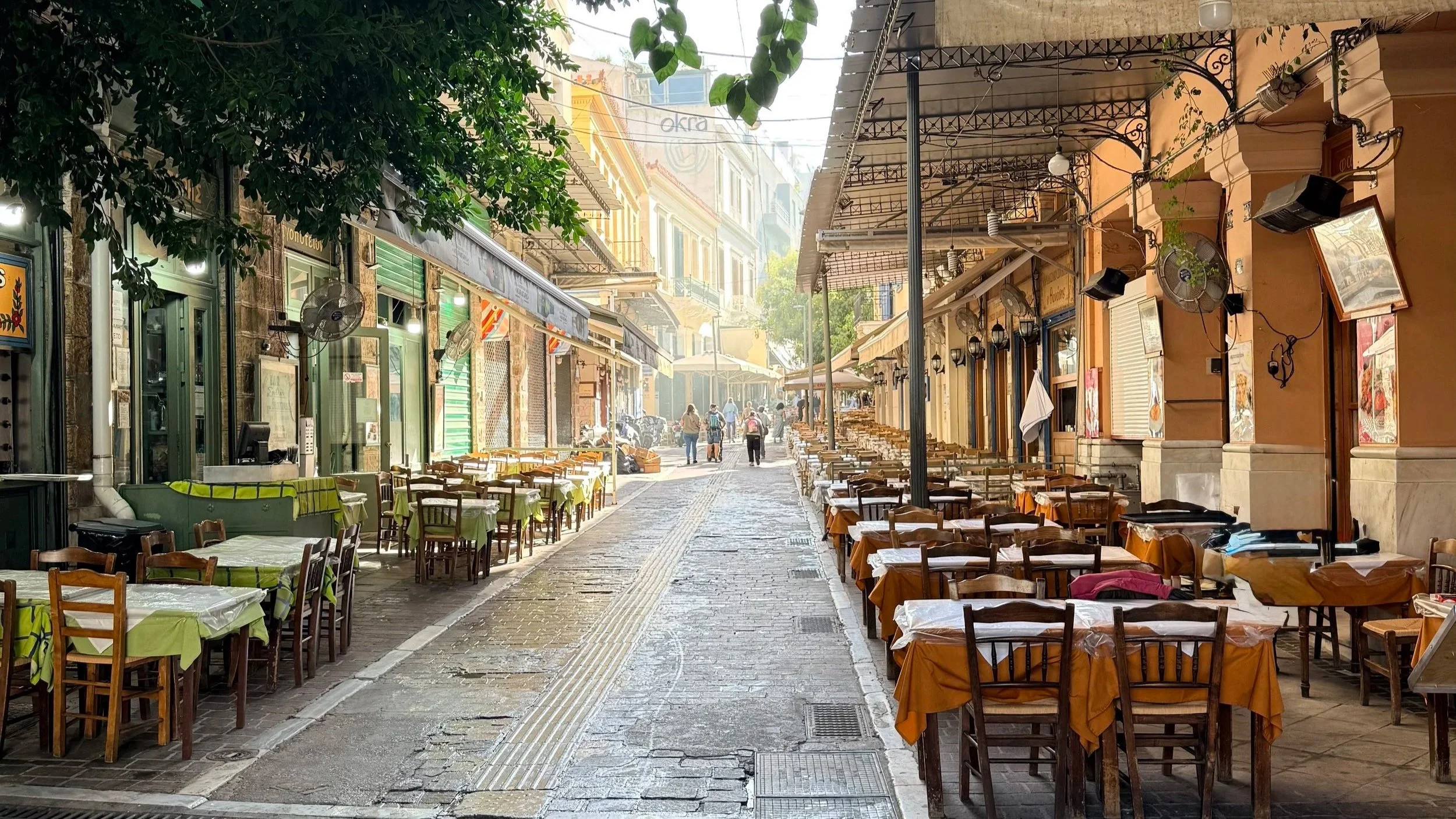
A pedestrian street in Athens before the day gets going. It does not stay this quiet for long.
The Dining Scene
The food in Athens surprised us. In a good way. It is incredibly fresh and surprisingly affordable. You can still sit down for a phenomenal dinner with wine for a fraction of what you would pay in other major Western European cities.
Liondi: Sometimes the best meals are the simplest. Located on the pedestrian-friendly Makrygianni Street right across from the Acropolis Museum, this spot captures the true spirit of Athens. The staff treated us like old friends immediately. Sitting at the outdoor tables as the sun sets with a view of the Sacred Rock is exactly what you picture when you book a trip to Greece.
Order This: The fresh Greek salad and the grilled meats. Order what the table next to you is having. That is usually the right call at a place like this.
Don't Miss: Ask for the house Leontiti wine. It is made from the family's own vineyard in the village of Liondi from Agiorgitiko grapes. You will not find it anywhere else.
Tudor Hall: Perched atop the King George Hotel right next door to the Grande Bretagne, this is our top pick for a fine-dining evening. And not just because it shares our last name. The rooftop setting offers front-row views of the illuminated Acropolis. The service is white-glove but never stuffy, and the Michelin-starred Mediterranean cuisine makes for a perfect night out.
Don't Miss: Book this weeks in advance. The Acropolis illuminated at night from that rooftop is a different city than the one you spent the day in.
Estiatorio Milos: You may know Milos from its locations in New York or Las Vegas, but dining at their flagship in Athens is different. Located near the Old Parliament in the Xenodocheio Milos hotel, this space feels distinctively local rather than touristy. The ritual here is legendary. You select your own fresh catch from the ice display, and they prepare it simply and perfectly.
Order This: Walk to the ice display, pick your fish, and tell them whole and grilled. That is the right answer every time.
Don't Miss: Let the manager order for you. The menu follows what came in that morning and they know better than anyone which fish is at its best that day.
Smile Restaurant: This is a family-run spot near the Acropolis Museum that has been serving home-cooked comfort food since 2002. It is accessible at ground level and the outdoor seating is perfect for people-watching.
Order This: The baklava. It comes from the mother's recipe and it might be the best version we had in the entire city.
Don't Miss: Even a coffee stop here turns into twenty minutes of watching the neighborhood move. Build in more time than you think you need.
Advisor Notes:
The "Plaka" Rule: The Plaka neighborhood is charming, but it is also tourist central. If a host is standing outside trying to drag you in with a menu in five languages, keep walking. The best spots do not need to beg you to enter.
Timing Matters: The Greeks eat late. If you show up to a taverna at 7:00 PM, you will likely be the only people there. The energy really starts picking up around 9:00 PM.
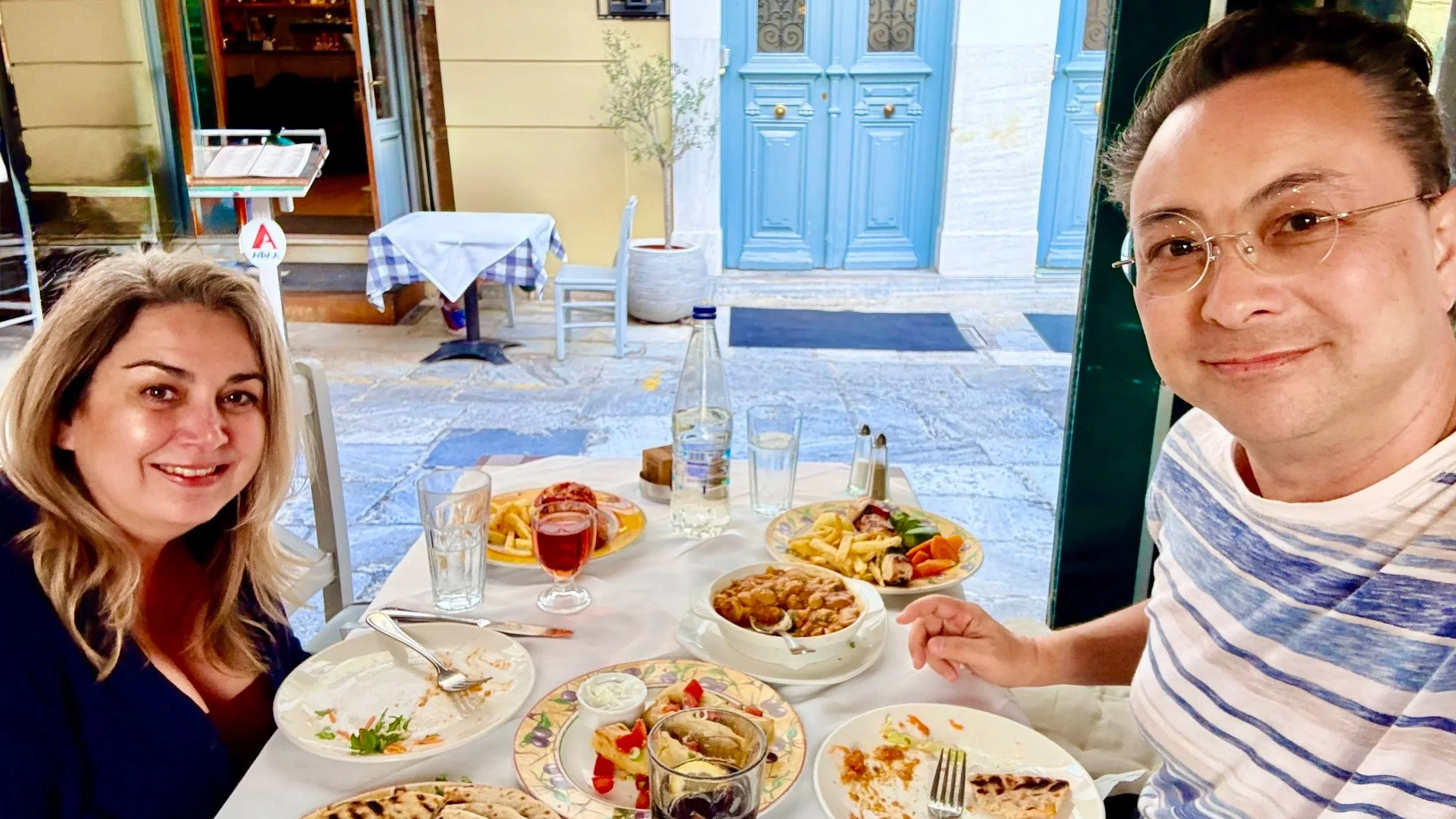
The table filled up faster than we expected. That is how it tends to go in Athens.
What to See
The Acropolis and Parthenon: Standing in front of the Parthenon never stops meaning something, no matter how many times you have seen photographs of it. The scale of it, the age of it, and the fact that it is still there above a functioning modern city produces a feeling that is difficult to prepare for. We go at 8 AM. The cruise ship crowds have not arrived yet, the heat has not built up yet, and the light at that hour on the marble is worth the early alarm.
Don't Miss: The view from the top is the obvious draw, but take a few minutes before you leave to look back down at the city spreading out below the hill. That perspective is the one we keep coming back to.
Accessibility: There is a dedicated wheelchair-accessible elevator on the North Slope near the Erechtheion. Access requires coordination in advance or a disability ID, not something you can arrange on the day.
The Acropolis Museum: Consistently ranked among the best museums in the world, the Acropolis Museum sits at the base of the hill and gives you the context for everything you just saw. It is the right order to do things: the hill first, then the museum, so the history fills in around what you experienced. The glass floors near the entrance reveal the ancient excavations beneath your feet and are positioned so that the view down into them works from any angle and any height. The top-floor Parthenon Gallery is rotated to align exactly with the orientation of the actual temple visible through the windows across the way. The first time you register that detail, it stops you.
Don't Miss: Stand in the Parthenon Gallery long enough for the alignment to really register.
Accessibility: The Acropolis Museum at the base of the hill is a different situation entirely. The full detail is in the museum entry above, but the short version is that it was built to be accessible from the ground up and delivers on that completely.
The Ancient Agora: This is where the daily life of ancient Athens actually happened. Where Socrates taught and Plato debated, where merchants and citizens moved through their ordinary days. It is less visited than the Acropolis and more intimate for it. You can take your time here and the site rewards that. The Stoa of Attalos, a fully reconstructed ancient building at the edge of the grounds, houses the on-site museum and has excellent air conditioning, which in a Greek summer is not a minor detail.
Don't Miss: The Stoa of Attalos itself, not just for the museum inside but for the experience of standing in a reconstructed ancient building and understanding the scale of what these structures actually were.
Accessibility: The Stoa has an elevator to the upper floor and is fully accessible. The surrounding grounds are a different matter, uneven gravel paths throughout, and the route up to the Temple of Hephaestus is a genuine challenge for manual wheelchairs. The Stoa and its immediate area are well worth the visit on their own even if the full grounds are not navigable.
Stavros Niarchos Foundation: Designed by Renzo Piano and home to the National Library and the Greek National Opera, the Stavros Niarchos Foundation is the right answer to the question of what modern Athens looks like at its best. It is the counterpoint to the ancient city and it is a beautiful place to spend an afternoon. Come in the late afternoon. Walk the park, watch the Dancing Fountains in the canal, and take the roof garden for the panoramic view over the city and out to the sea. The light at that hour over the Saronic Gulf is its own reward.
Don't Miss: The roof garden at sunset. The view takes in both the city and the water, and it is one of the few places in Athens where you see both at once.
Accessibility: The entire complex is barrier-free. Ramps connect every level, the paths are wide and smooth, and the rooftop is fully accessible by elevator. It is the most effortless major site we visited in Athens.
Cape Sounion: The drive south along the Athenian Riviera to Cape Sounion is worth doing for the drive alone. The coastline unfolds alongside you for most of the route and it is a picturesque stretch of road. The destination is the Temple of Poseidon, perched on a cliff edge above the Aegean, and the sunset there is the best we have seen in Greece.
Don't Miss: Time your arrival for 45 minutes before sunset. The light on the temple columns as the sun goes down over the water is the image you came for.
Accessibility: The temple terrain is rugged and has limited ramps. We recommend arranging a private van for the trip. There is a paved path to a lower viewing area and cafe terrace that delivers the full dramatic view over the Aegean without requiring the clifftop hike, and the view from there is excellent.
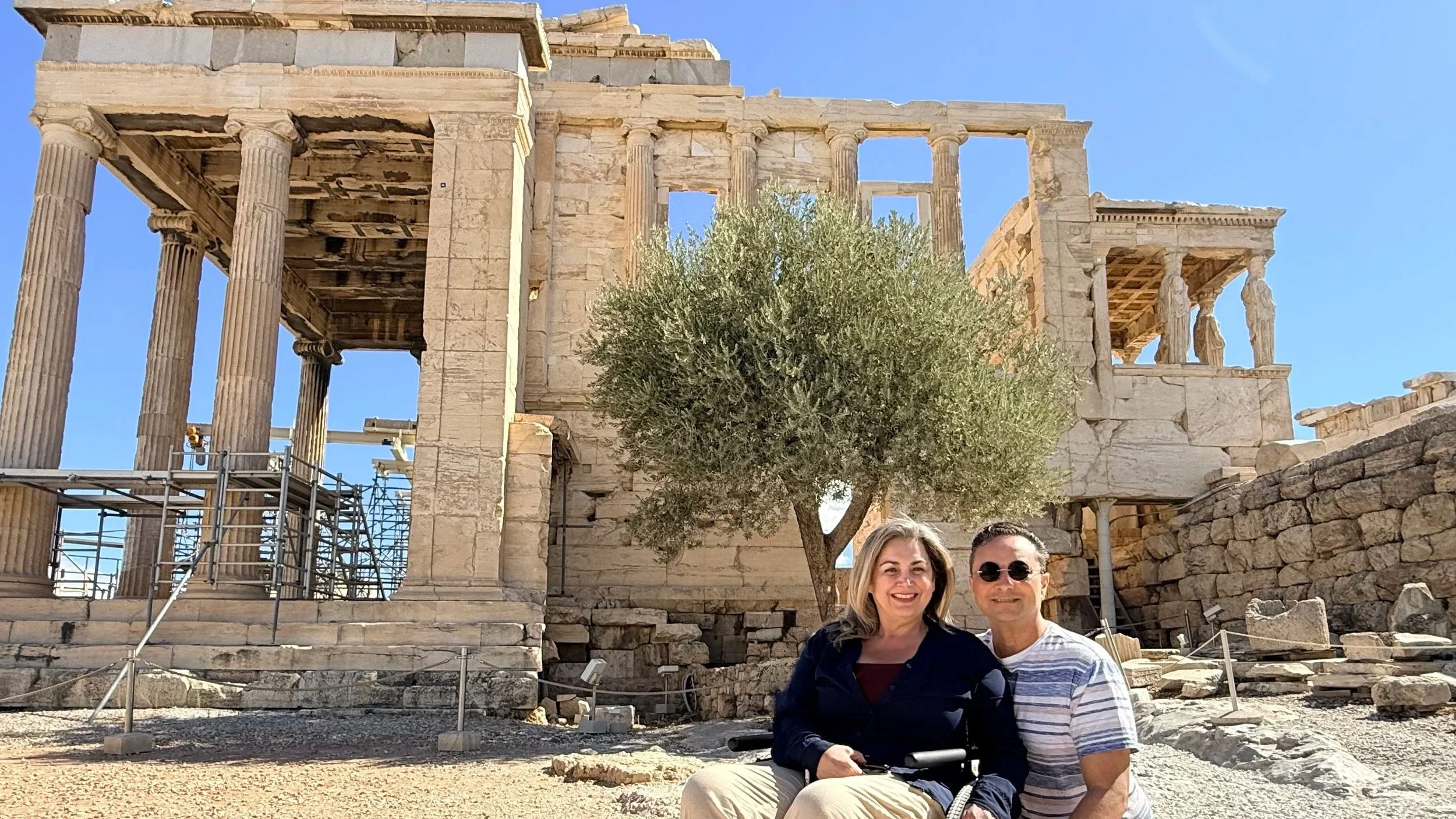
The Acropolis is bigger than most people expect and quieter in the corners. The Erechtheion is one of the corners worth finding.
What Stayed with Us
One night we ended up at a taverna with friends and stayed far longer than any of us had planned. The place was packed and completely open to the street. No walls, no windows, just warm air and the noise of a full room. The staff found room for us anyway, pulling chairs from somewhere and making us feel like regulars from the moment we sat down. Greek specialties kept arriving, then a wave of desserts, then mastiha, which we loved. None of us wanted to be the one to suggest leaving.
The elevator at the Acropolis moves slowly, and we were glad for it. As it climbed, Athens came into view in pieces, rooftops first, then hillsides, the city spreading out further than we expected in every direction. We weren't in a rush to reach the top. The ride up was the thing, watching it all open up at a pace that actually let you take it in.
The bakery at our hotel turned out to be one of the better decisions we made all trip. We asked the staff what to order, went with their recommendations, and ended up with more pastries than we'd planned, none of which we could have named, all of which were exactly right. We took our coffee outside into near-perfect weather and watched Athens move at its own pace for an hour. It was one of those slow mornings that earns its place in the memory.
Our Favorite Discovery: Mastiha
Mastiha is not just a drink. It is a flavor profile that does not have an equivalent anywhere else: slightly sweet, with aromatic hints of pine and herbs, derived from the resin of trees on the island of Chios. It became our preferred way to end a meal in Athens and is worth looking for at the airport on the way home. A bottle in the carry-on is one of the better things Greece offers to take back, and it reliably starts a conversation.
Accessibility
The Terrain: Athens is a city of contrasts. Modern areas like Syntagma Square and Ermou Street are smooth, wide, and well-paved. The historic Plaka and Anafiotika neighborhoods are a different story: uneven cobblestones, narrow alleys, and steep inclines. Essential to see, but they demand a slower pace with more care.
Getting Around: The Athens Metro (Lines 2 and 3) is modern, clean, and notably accessible, with elevators and level boarding at most major stations. It can be faster than sitting in surface traffic.
The Acropolis: There is an accessible elevator on the North Slope, near the Erechtheion, that bypasses the slippery marble steps entirely. You cannot simply show up and use it. It requires a disability ID or advance authorization, which is exactly why having a private guide here makes such a difference. The Acropolis Museum at the base of the hill is a completely different situation. It was designed from the ground up to be fully ramped and barrier-free, and it is one of the most thoughtfully accessible museum spaces we have visited.
The "Philoxenia" Factor: Greece is famous for philoxenia and practically speaking it is a real asset. Where the infrastructure falls short, the people step in. Waiters move tables without being asked. Locals offer directions before you look lost. The sidewalks might fail you occasionally, but the Greeks won't.
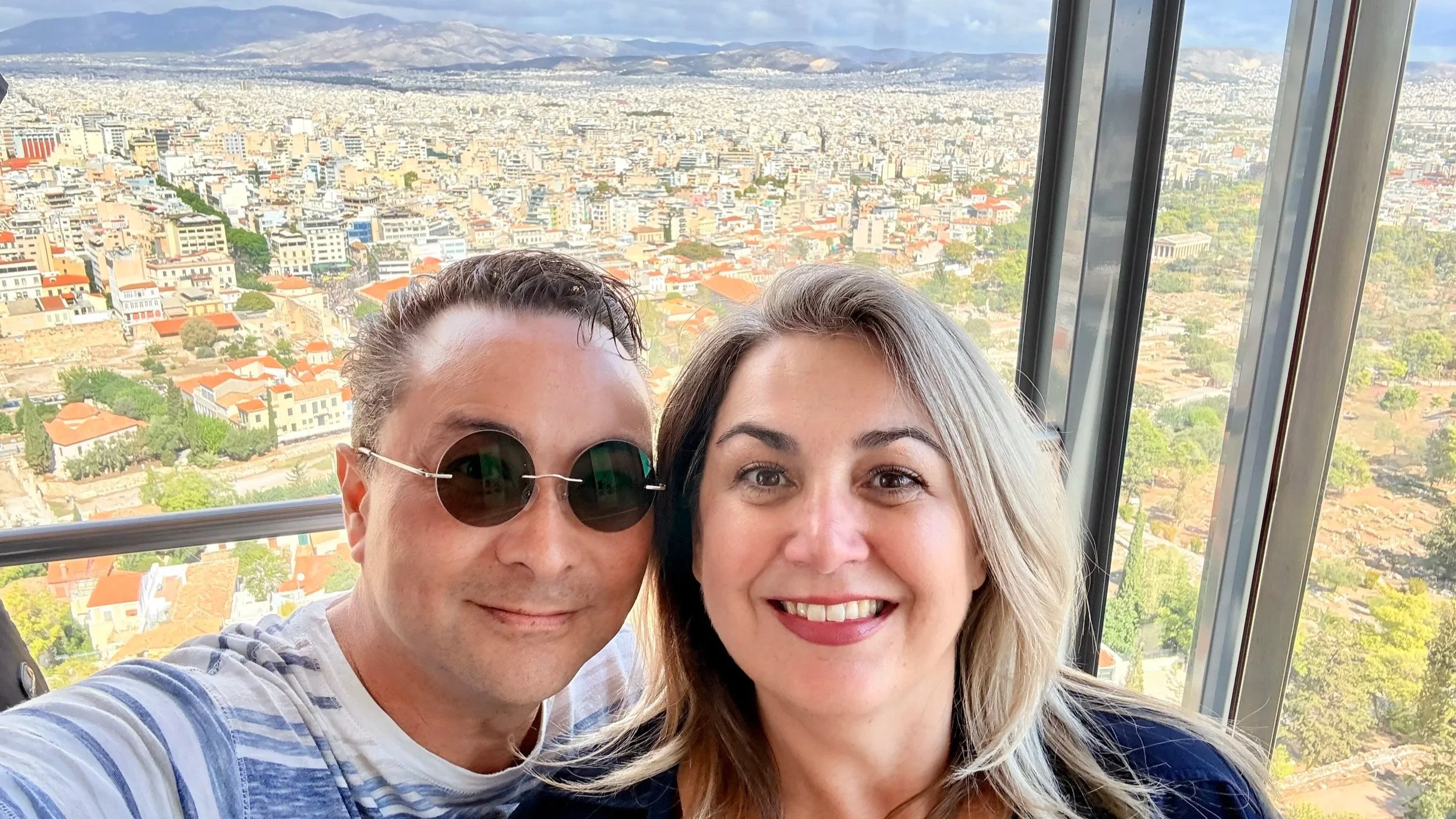
The city below us is four million people and three thousand years of history. From up here it just looks like rooftops in every direction.
The TudorTravels Perspective
Athens requires a different kind of preparation than most European cities. Not more effort, but more thought about what you are going to before you get there. The streets are uneven, the summer heat is not easily ignored especially on the exposed Acropolis hillside, and the historical density of the place means you can miss a great deal moving at the wrong pace. For the traveler who arrives with a plan and some inside knowledge, Athens delivers things that are harder to find anywhere else in Europe.
One thing Athens does that no other major European city quite replicates: the Parthenon is visible from almost everywhere in the city. It sits above everything and stays there regardless of where you are, which means you always know where you are. In a city that can feel disorienting on the ground, that constant reference point is more useful than it sounds.
The luxury hotel market here is more limited than what you will find in Rome, Paris, or London. The options that exist are strong, and the category is growing, but the selection is narrower. That means knowing which property fits the kind of trip you are taking matters more than in cities where you have a dozen viable options at every price point. Book early and know why you are choosing what you are choosing.
What Athens also offers, and what is easy to underestimate until you are there, is value. Compared to most Western European capitals of similar cultural weight, the overall cost of a trip here is meaningfully lower. That gap shows up in hotel rates, in the price of activities and entry fees, and in what a day of moving around the city actually costs. It gives the trip a different kind of flexibility. The same budget that limits you elsewhere gives you more room to stay longer and move more freely here.
The things that trip most first-timers up are predictable. Seeing the Acropolis at the wrong hour with a tour group ahead of you is a fundamentally different experience from being there early, before the crowds arrive. Which hotel puts you in the right part of the city for the kind of trip you are taking.
Inspired by Athens? Contact us to plan your time there, or anywhere else in Greece you want to explore.