
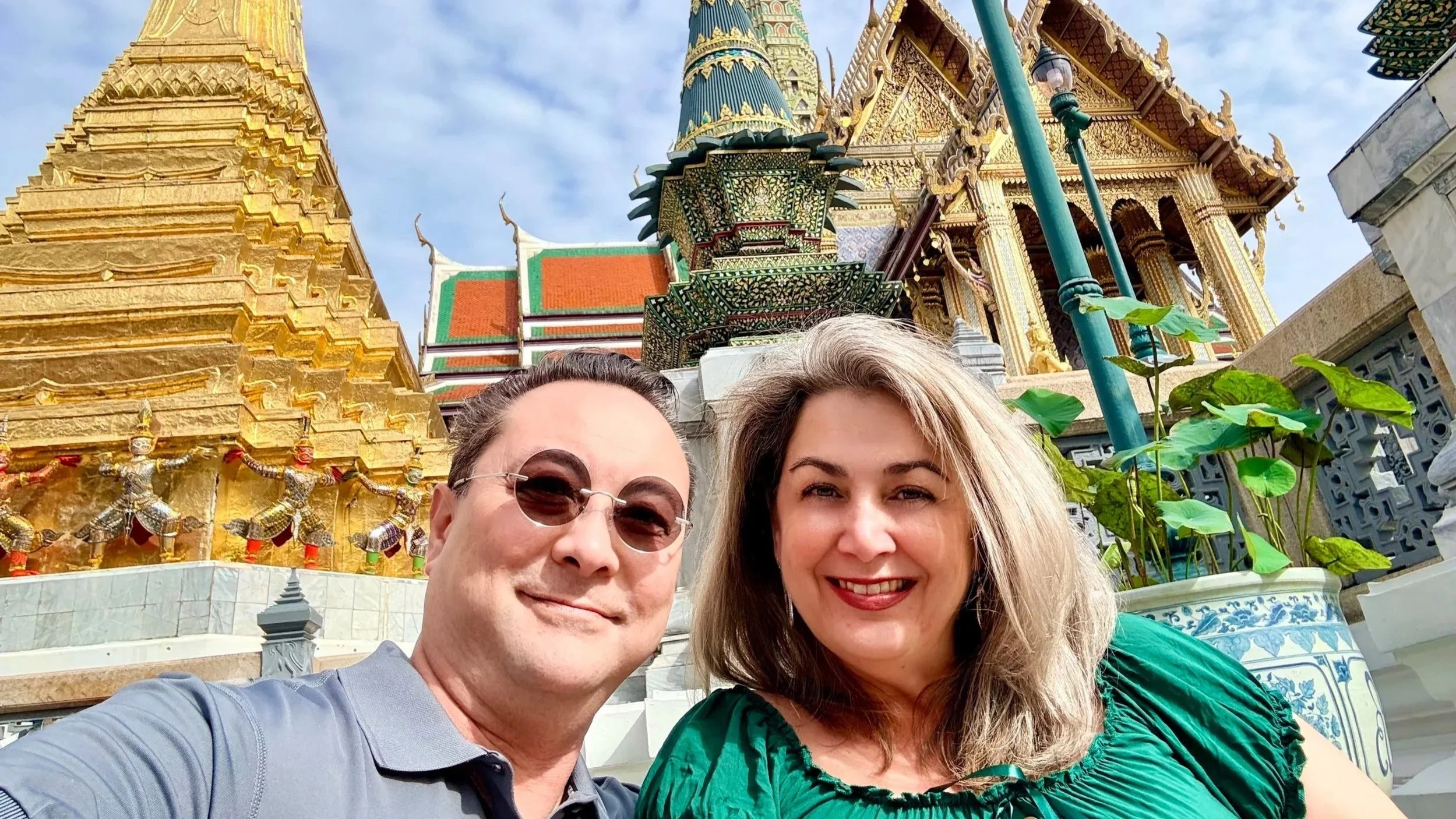
The temples at the Grand Palace are built to make you feel small. They succeed.
Bangkok hits you the moment you step outside the airport. The humidity comes first. Then the smell of jasmine and grilling satay, the neon light cutting through the haze, the hum of ten thousand engines. We have visited half a dozen times, and it still hits us the same way every time. The trip where we stayed for two weeks, no agenda, just Bangkok, is the one that changed how we understood the city. By the end we had eaten mango sticky rice enough times that some of the vendors knew us by sight. We had stopped looking at the map and were navigating by landmarks we had invented ourselves. We were nowhere close to being done.
The people carry themselves with a grace that is hard to explain until you feel it. A warmth that makes even a transaction feel like a small act of hospitality. Then there is the food, which is, without qualification, the best we have eaten anywhere in the world. That is not hyperbole. Bangkok takes almost a full day to get to from anywhere in the US. The mangoes alone in May, when the season peaks and the fruit is fiber-free and impossibly ripe, make the argument for going anyway. And underneath all of it, the city holds two things simultaneously that should not go together: deep Buddhist tradition and full-velocity modern luxury. It does not try to reconcile them. It just runs both at the same time, and somehow that tension is what makes the place electric.
First-time visitors often brace for chaos. The traffic is real. The heat is real. But Bangkok rewards the people who lean into it rather than manage it from a distance. The ones who walk past the hotel lobby and into the neighborhood. Who order what the server recommends, even if they have no idea what it is. Who stay long enough to stop being surprised. Most people who fly to Thailand treat Bangkok as a stopover, a night or two before heading down to the amazing islands the country is famous for. That is a significant mistake. Bangkok has one of the best luxury hotel and dining scenes in the world, and most visitors fly right past it.
The Hotels
Bangkok has one of the most competitive luxury hotel scenes in the world. The service standards here are incredibly high, and the properties are architectural marvels.
Four Seasons Hotel Bangkok at Chao Phraya River: When this property opened, it completely redefined the riverfront, and the first time we walked through it we immediately understood why. It does not feel like a high-rise city hotel. It feels like a sprawling urban resort designed around water and light. The architect Jean-Michel Gathy used cascading courtyards and water features to lead your eye down to the Chao Phraya River, and the effect is immediate. The city noise disappears within about thirty seconds of arriving. We have spent multiple evenings at the BKK Social Club, which has been ranked in Asia's 50 Best Bars every year since opening, including a year at number one. The 1920s Buenos Aires atmosphere, the cocktails, and the energy of the room are unlike anything else in Bangkok. And being on the river means your mornings are as good as your nights. We still talk about sitting at breakfast watching the long-tail boats move down the Chao Phraya. It is a perfect way to start a day in the city.
Book This: A river-facing room or suite. The views of the Chao Phraya are the whole point, and the price difference from a garden-facing room is worth it.
Accessibility: As a new build, the accessibility here is exceptional. Wide pathways and ramps connect the entire riverside promenade, galleries, and restaurants, and the whole property can be enjoyed without encountering a single step.
Mandarin Oriental, Bangkok: This is the true Grande Dame of Bangkok. For nearly 150 years it has set the standard for luxury on the river. You can feel the history the moment you walk into the lobby, and the famous floor-to-ceiling flower arrangements stop you in your tracks every single time. But the real draw is not the history. It is the staff. They knew our names before we checked in, and the service never let up from that moment. The hotel just completed a $100 million renovation ahead of its 150th anniversary in 2026, with new interiors throughout the Authors' and Garden Wings and a transformation of the dining program that brings Anne-Sophie Pic, the world's most decorated female chef, to Le Normandie. A private shuttle boat takes you across the river to the spa, fitness center, and cooking school, which is one of those touches that makes the whole experience feel unlike any other hotel in the city. High tea at the Authors' Lounge is one of the great Bangkok rituals, and The Bamboo Bar, the city's original jazz venue since 1953, remains as good as its reputation.
Book This: One of the named literary suites in the Authors' Wing, such as the Somerset Maugham Suite or the Graham Greene Suite. They are the most storied rooms in Bangkok and worth the splurge for a special occasion.
Accessibility: The property spans both sides of the river, with the spa, fitness center, and cooking school accessible via the private shuttle boat. The boarding experience is flat and level, though guests with significant mobility needs should contact the hotel ahead of arrival to plan accordingly.
Waldorf Astoria Bangkok: The Waldorf Astoria Bangkok sits at the center of the shopping district near the Erawan Shrine in the Magnolias Ratchadamri Boulevard building. The design is inspired by the petals of a magnolia flower, with a curvilinear form that offers a softer, more organic aesthetic than a typical glass tower. The service is sharp and attentive, but the architecture steals the show. The crowning jewel is The Loft on level 56, a New York-inspired bar with Art Nouveau touches and sweeping views of the city skyline that we were not fully prepared for the first time we went up. It feels intimate and exclusive in a way the larger riverside resorts simply cannot replicate. And the breakfast. We had heard about the truffle eggs before our first stay and assumed they were overhyped. They are not overhyped. The curved layout of the restaurant means every table sits next to a window, and we have never had a bad seat.
Book This: A room on the upper guest floors. The hotel's accommodations occupy floors 6 to 17 of a 60-storey tower, and requesting floors 14 or above gets you meaningfully better views over the Royal Sports Club and the city.
Accessibility: The building is a modern high-rise with lifts throughout and level access from the street. The central location also puts you steps from the BTS Skytrain, one of the most accessible transit systems in Southeast Asia.
Park Hyatt Bangkok: Sitting atop the Central Embassy luxury mall, the Park Hyatt is instantly recognizable by its twisted-coil architecture. Inside, the design is sophisticated and minimalist, with calming neutral tones that feel like a deep exhale after a day in the busy streets. We spent multiple days at the 40-metre saltwater infinity pool on the 9th floor and were never in a rush to leave. It is the perfect spot for a pool, sitting among landscaped gardens above the city with views over Lumphini Park. The most practical feature of this hotel is that it occupies the top floors of the Central Embassy building, which means you can reach Eathai, the exceptional high-end food court in the basement, and dozens of restaurants without ever stepping outside into the heat and humidity. We have eaten our way through more of Eathai than we can responsibly admit. After a long day of touring Bangkok, having that many great options a single elevator ride away is a luxury we have come to rely on.
Book This: A high-floor room or suite on the park-facing side for views over Lumphini Park and the skyline.
Accessibility: Because the hotel sits inside the Central Embassy building, guests never need to navigate outdoor steps or street crossings to reach multiple dining and retail options. The mall and hotel are fully lift-accessible throughout.
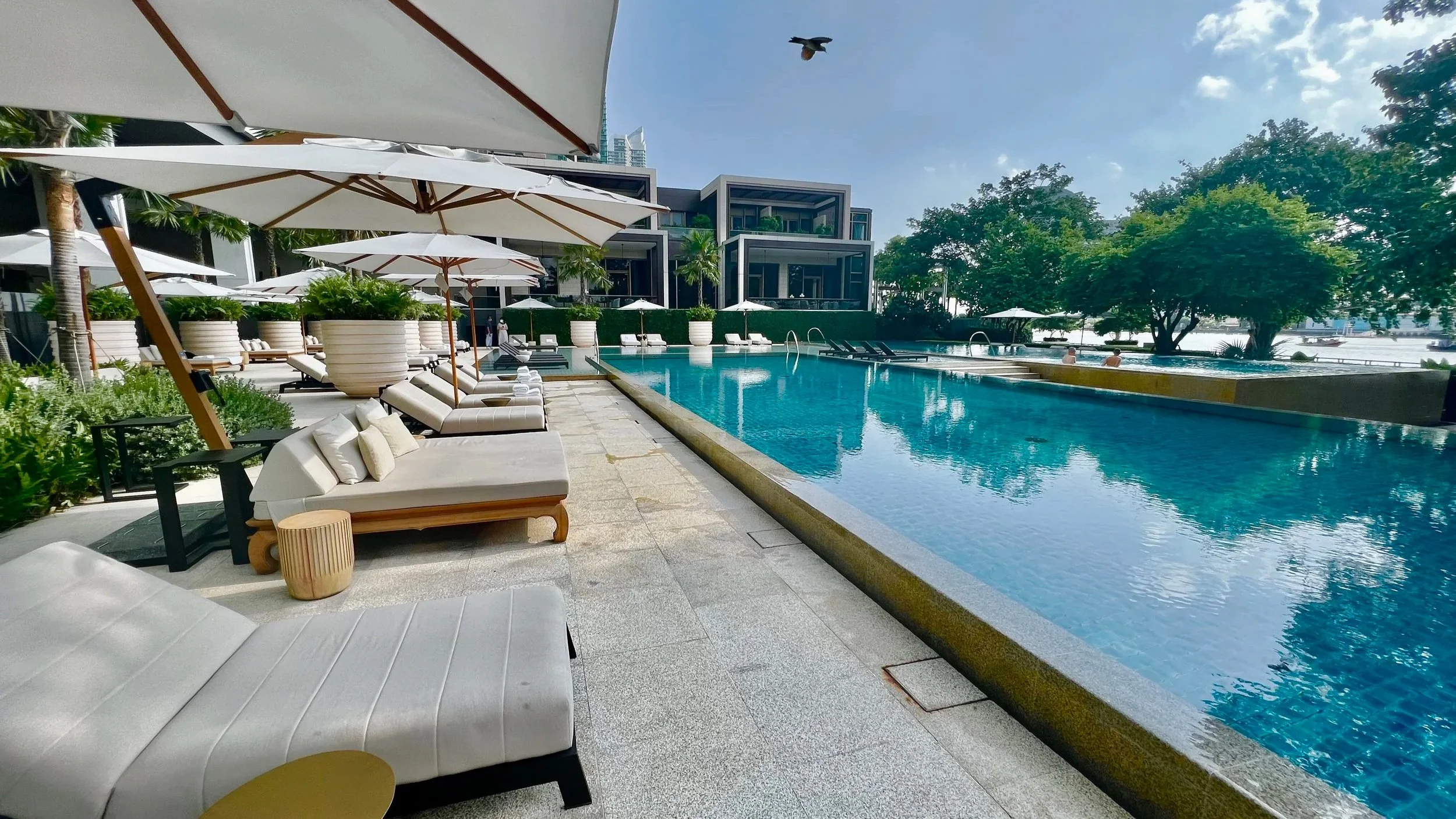
The river traffic on the Chao Phraya never stops. Watching it from poolside is the right way to see it.
The Dining Scene
If you are new to Southeast Asia, prepare to have your mind blown by the breakfast buffets at luxury hotels. This is not just a meal. It is an event. The variety, from fresh coconuts and exotic fruits to made-to-order noodle stations, operates on a completely different level than what we see at home. Do not sleep in.
Anne-Sophie Pic at Le Normandie: Le Normandie has been operating at the Mandarin Oriental since 1958. Chef Anne-Sophie Pic is the first woman in the restaurant's history to have her name on the door, and she brings her Suffusion philosophy with her. Aromatic layers of bergamot, tea, and herbs woven through French haute cuisine in a way that does not feel like fusion so much as a completely new category. We had one of our best meals ever here.
Order This: The tasting menu. Let the sommelier handle the wine pairing. A word of warning: he is notoriously generous. We barely made it back across the river to The Peninsula on our last visit.
Don't Miss: Request a table on the river side. The Chao Phraya at night from that window is a completely different angle on Bangkok than anything you will see from the street.
Le Du: Ranked No. 30 on the World's 50 Best Restaurants in 2025, this is Chef Ton Tassanakajohn's tribute to seasonal Thai ingredients prepared through French technique. The name means Season in Thai, and the menu changes every couple of months to reflect what is actually growing right now. It is approachable and vibrant rather than stuffy, making it one of the best introductions to fine dining in the city.
Order This: The grouper with tofu and white chives. The tofu fries like a perfect crackling and the chives come in a red pepper sauce that ties the whole dish together.
Don't Miss: The ceiling is covered with 20,000 test tubes. Spend a moment with it before your first dish arrives.
Jay Fai: You have likely seen her on Netflix wearing her signature ski goggles to protect against the heat of the wok. Jay Fai is the queen of Bangkok street food and the first street stall to earn a Michelin star. The crab omelet has earned its reputation. It is a massive, golden cylinder packed with a ridiculous amount of fresh, sweet crab meat. But even if you do not eat here, just walking by is an experience. You can physically feel the heat coming off those woks from the sidewalk.
Order This: The crab omelet. There is no debate on this one. Everything else is secondary.
Don't Miss: Cash only, no card payments. And do not take photos or videos of the chef. The staff are serious about both.
Thipsamai: This is the historic heavyweight for Pad Thai. The Superb Pad Thai comes wrapped in a delicate, paper-thin egg crepe with massive river prawns. It is sweeter than the Pad Thai you might be used to at home, but it is the reference standard for the dish.
Order This: The Superb Pad Thai. Wrapped in a paper-thin egg crepe with river prawns. Nothing else at this table matters as much.
Don't Miss: If the line is too long, walk a few doors down to Pad Thai Fai Taalu. It is Michelin Bib Gourmand and many foodies argue it is actually better, with a smokier charcoal-fired profile.
Beirut Restaurant: Sometimes you need a break from the heat and the spice. Beirut has several branches across the city, and the hummus, tabbouleh, and grilled meats are consistently fresh and flavorful. It is a favorite among expats for a reason.
Order This: The chicken shawarma, the hummus, and the tabbouleh. Simple, fresh, and exactly what your palate needs after a few days of Bangkok intensity.
Don't Miss: This is what you eat on the fourth or fifth day when the heat and spice have finally caught up with you. Do not wait until you actually need it to find the nearest branch.
Street Food: The Real Deal vs. The "Safe" Bet
For the Brave: Yaowarat Road in Chinatown at night is a neon-lit feast for the senses. It is crowded, hot, and delicious. Grab some roasted chestnuts or fresh wok-fried noodles and soak in the energy. It is chaotic, but it is one of the best food scenes on earth.
For the Cautious: If you are leery about hygiene or the heat, head to SookSiam on the ground floor of ICONSIAM or Eathai in the basement of Central Embassy. Both deliver authentic flavors in air-conditioned comfort.
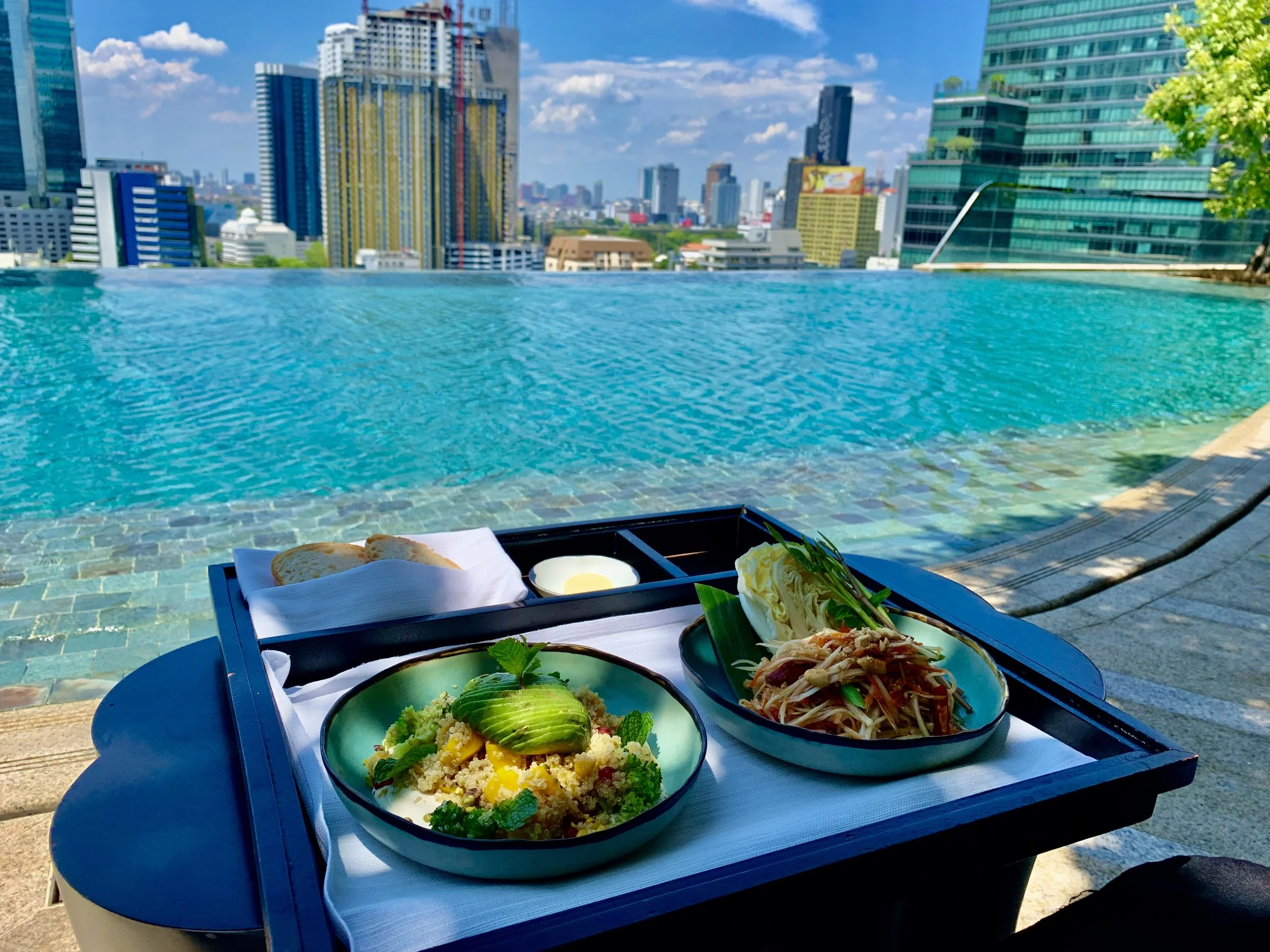
The Bangkok skyline looks different from up here. Lunch made it even better.
What to See
The Grand Palace & Wat Phra Kaew: Nothing prepares you for the Grand Palace. The complex is the spiritual and historical center of Thailand, and the scale of it stops you the moment you walk through the gates. Millions of pieces of colored glass and gold leaf catch the sun from every surface, and the longer you look, the more detail you find. Inside Wat Phra Kaew, the Emerald Buddha sits high on its throne, small in size but carrying a weight that everyone in the room seems to feel. You do not need to be religious to understand why this is the most revered image in the country. We have been twice and still did not feel like we saw everything.
Don't Miss: Arrive when the gates open at 8:30am. The complex has almost no shade and the heat becomes punishing by mid-morning. Dress code is strictly enforced: shoulders and knees must be fully covered. Sarongs are available to borrow at the entrance if you need them.
Accessibility: The complex covers a large area with uneven stone surfaces throughout. Most areas are reachable on foot but some temple interiors have steps with no alternative access.
Wat Pho: A short walk from the Grand Palace, Wat Pho is home to one of the most memorable sights in the city: a 46-meter reclining Buddha, gold-plated and almost impossibly long, filling the entire temple hall. The soles of the feet are inlaid with 108 mother-of-pearl symbols and are worth stopping at for as long as you can. We visited once shortly after pandemic restrictions lifted, when the temple was nearly empty, and that kind of quiet time in that space was something we didn't expect to stay with us the way it did. Normally the hall fills with the sound of coins dropping into the row of offering bowls along the wall, but the scale of the Buddha seems to ask for stillness regardless of the crowd. Before you leave, stop at the on-site massage school. It is not a spa, but it may be the most authentic Thai massage you will find anywhere.
Don't Miss: Ask for the two-hour traditional treatment. The setting is basic and that is the point. Book it before you leave the temple grounds rather than telling yourself you will come back.
Accessibility: The main hall has a step entrance but is otherwise level inside. The outer temple grounds involve some uneven paths.
Chatuchak Weekend Market:More than 15,000 stalls spread across an open-air market that runs on weekends only. The range is difficult to describe: vintage sneakers, young designer fashion, ceramics, plants, street food, and things you cannot quite categorize. It is intense and hot and worth every minute of it. Go early before the heat peaks and give yourself more time than you think you need. You will get turned around, and that is half the experience.
Don't Miss: The ceramics and independent fashion sections are worth seeking out specifically. Some of the best young Thai designers sell here before they open standalone stores.
Accessibility: The market is outdoors on largely flat ground but gets very crowded. Stall aisles are narrow. Typically open 9am to 6pm.
The Midnight Tuk Tuk Food Tour:This is the most fun we have had in Bangkok, and we recommend it without hesitation. A private midnight food tour by tuk tuk takes you through the city after the traffic has cleared, stopping at local spots you would not find on your own. The Flower Market is one of the best stops on the route: it runs all day but comes fully alive around 2am when the wholesale vendors are setting up for the morning, and the sheer volume of flowers moving through that market at that hour is something to see.
Don't Miss: Book private rather than group if you can. The itinerary becomes more flexible and the whole experience is different.
Accessibility: Tuk tuks require stepping up and sitting low. Some stops involve narrow street markets. Confirm with your tour operator if mobility is a concern.
Khlong Tour of Thonburi: Getting on the water is the best way to understand how Bangkok actually grew. A private long-tail boat through the canals of Thonburi takes you past wooden houses on stilts, floating vendors, and monitor lizards sunbathing on the banks. The pace of life here is slower and the city feels closer to what it looked like decades ago. Ask your operator to include Wat Paknam Phasi Charoen on the route, where a 226-foot golden Buddha now towers over the surrounding neighborhood and has become one of the more striking additions to the Bangkok skyline.
Don't Miss: Negotiate the route and duration before you board. Two hours gives you enough time to take it in without rushing.
Accessibility: Long-tail boats sit low in the water and require stepping down from a dock. Not suitable for guests with significant mobility limitations.
Beyond Bangkok
Ayutthaya: About an hour north, Ayutthaya was the former capital of the kingdom before Bangkok and is now a UNESCO World Heritage site. The ruins are spread across a small island and are manageable as a day trip: headless Buddhas half-swallowed by tree roots, enormous prangs rising above the surrounding fields, and far fewer crowds than anything inside the city. Many visitors take the train one way and consider a river cruise for the return.
Hua Hin: If you are not heading south to the islands, spend a couple of days in Hua Hin. It is about three to three-and-a-half hours from Bangkok and is where the Thai Royal Family has vacationed since the 1920s, which tells you something about the quality of hospitality here. The beaches are not the turquoise of Phuket or Samui, but the seafood is excellent, the pace is relaxed, and it is one of the better ways to experience Thai culture outside the capital.
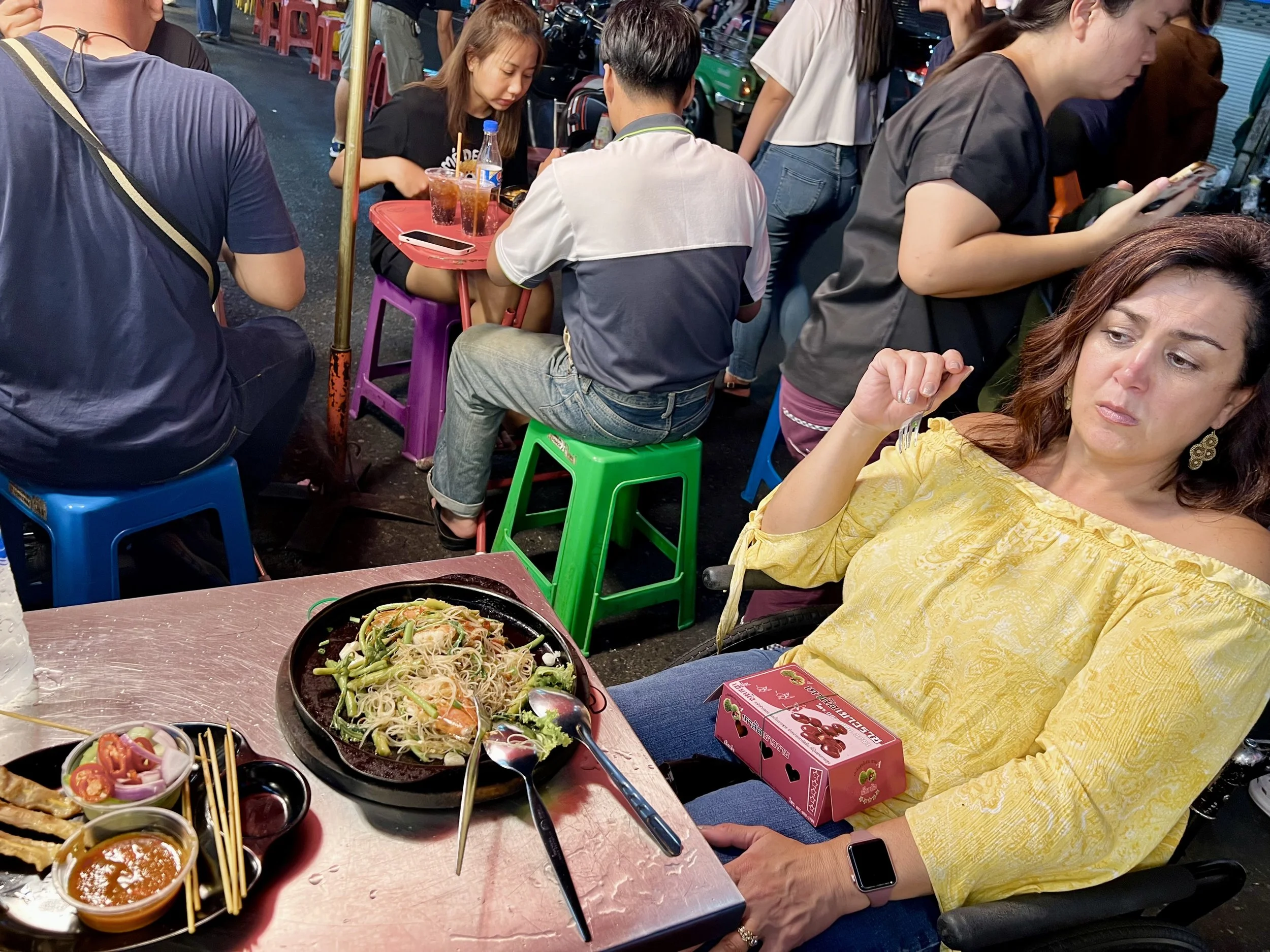
Night market noodles, colorful tables, no idea what half the menu said. Perfect.
What Stayed with Us
Cruising the Chao Phraya on a long-tail boat is one of those experiences that looks great in theory and turns out to be even better. The river is wide and busy with ferries and barges, and the city opens up differently from the water than it ever does from the street. We floated past temple spires, riverside hotels, and the kind of wooden structures that make you realize how much of Bangkok's history lives right on the bank. It is the version of the city we think about most when we think about going back.
Bangkok's night markets are worth an entire evening on their own. The food carts stretched in every direction and we spent more time looking than eating, trying to figure out what everything was before committing. The variety was staggering: grilled meats, noodle soups, things we could not identify but pointed at anyway. We found a spot to sit and watched the crowd move for a while. That combination of food, noise, and people watching is something you can only really get here.
One day we did nothing but sit at the infinity edge pool with friends. Lunch arrived poolside. Nobody was in a rush to be anywhere. The city stretched out in front of us and we watched it from the water for hours. It sounds simple and it was, and it was one of the best days of the trip.
Our Favorite Discovery: The Daily Massage Ritual
Thai massage is famous and we knew it before we arrived. What we did not expect was how quickly it would restructure our days. The technique is its own thing: part deep pressure, part assisted stretching, closer to movement work than what a Western spa delivers. The skill level holds up everywhere, from a proper street parlor to a full hotel spa treatment. After a morning running around Bangkok and then lunch somewhere too good to rush, an hour (or two) being massaged in a cool room resets everything. It is not a luxury here. It is simply part of how the day works. We tried to keep up the habit at home. It is not the same.
Accessibility
The Streets: The physical terrain is somewhat difficult. Sidewalks are often uneven, high-curbed, or blocked entirely by street stalls and utility poles. This is not something that planning eliminates. It is just the nature of the city, and it is worth knowing before you arrive.
Getting Around: Do not plan to navigate most streets independently. A private driver with a van for the duration of the stay removes most of the friction. Tuk-tuks require standing and transferring into the vehicle, so they may not be a workable option depending on your mobility limitations. For transit, the MRT subway tends to have more reliable elevators than the BTS Skytrain and is worth knowing as an alternative for certain routes. The Skywalks in the Siam and Chit Lom districts are covered and connect several malls and hotels, but they have steps in some places and are not enclosed, so they are more useful as a partial solution than a reliable one.
The Temples: The Grand Palace and Wat Pho both require managing steps to enter the temple buildings themselves. If steps are not manageable, the interiors will not be accessible, though the outer grounds can still be mostly experienced and are still worthwhile. Going early matters regardless, both for the heat and for the crowd levels.
The People: Bangkok's accessibility challenges are real, but the people here consistently fill the gaps. We have had restaurant staff rearrange entire seating areas without being asked. We have had strangers on a dock step in to help us up a steep ramp during a rainstorm. The warmth here is not a tourism slogan. It is how things actually work.
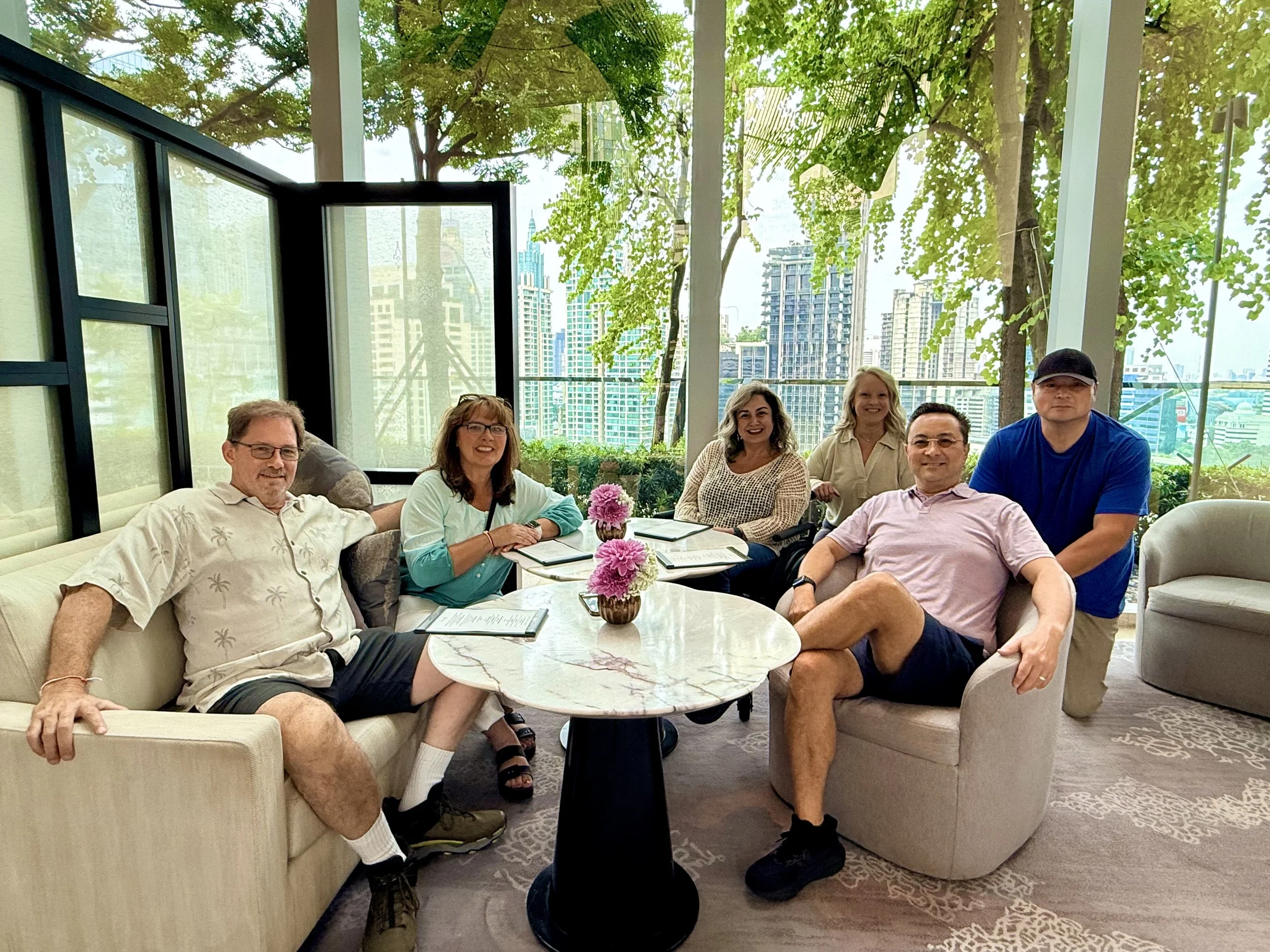
Some of our favorite people, one of our favorite cities. This is what Bangkok looked like that afternoon.
The TudorTravels Perspective
Bangkok is not a beach trip. It is a city trip in the fullest sense: layered history, a dining scene that runs from street stalls to some of the best restaurants in the world, and a pace that keeps you engaged from the first morning to the last. What you need is an appetite for food, for watching how a city moves, for the particular pleasure of wandering through a market or a mall that operates on a completely different scale than anything at home. It is also one of the great shopping cities in the world, and both the food and the shopping hold at every price point, which is rarer than it sounds.
The middle of the day is when Bangkok's heat makes its presence known, and that is when the trip slows down on purpose. The hotels here are built for exactly that pause. Build massage into the afternoon as well. It is everywhere in this city, at every price point, and the afternoon is when you will appreciate it most.
As for where to stay: the river hotels like the Mandarin Oriental and Four Seasons give you water views and a more resort-like pace. Staying central, near properties like the Waldorf Astoria or the Park Hyatt, puts you closer to the best dining concentrations and the high-end malls. Neither is the wrong answer. They are different trips. Spending a few nights at each, if the schedule allows, is the most complete version of Bangkok we know.
Bangkok trips succeed or fail on decisions most people do not know to make until they have already made the wrong ones: which neighborhood to base yourself in, which operators actually know the city, how to pace the days around the heat and the distances. Arrive with those things settled and the city rewards you. Arrive without them and you spend the first two days learning what you should have known before you left.
Inspired by Bangkok? Contact us to plan your time there, or anywhere else in Southeast Asia you want to discover.