
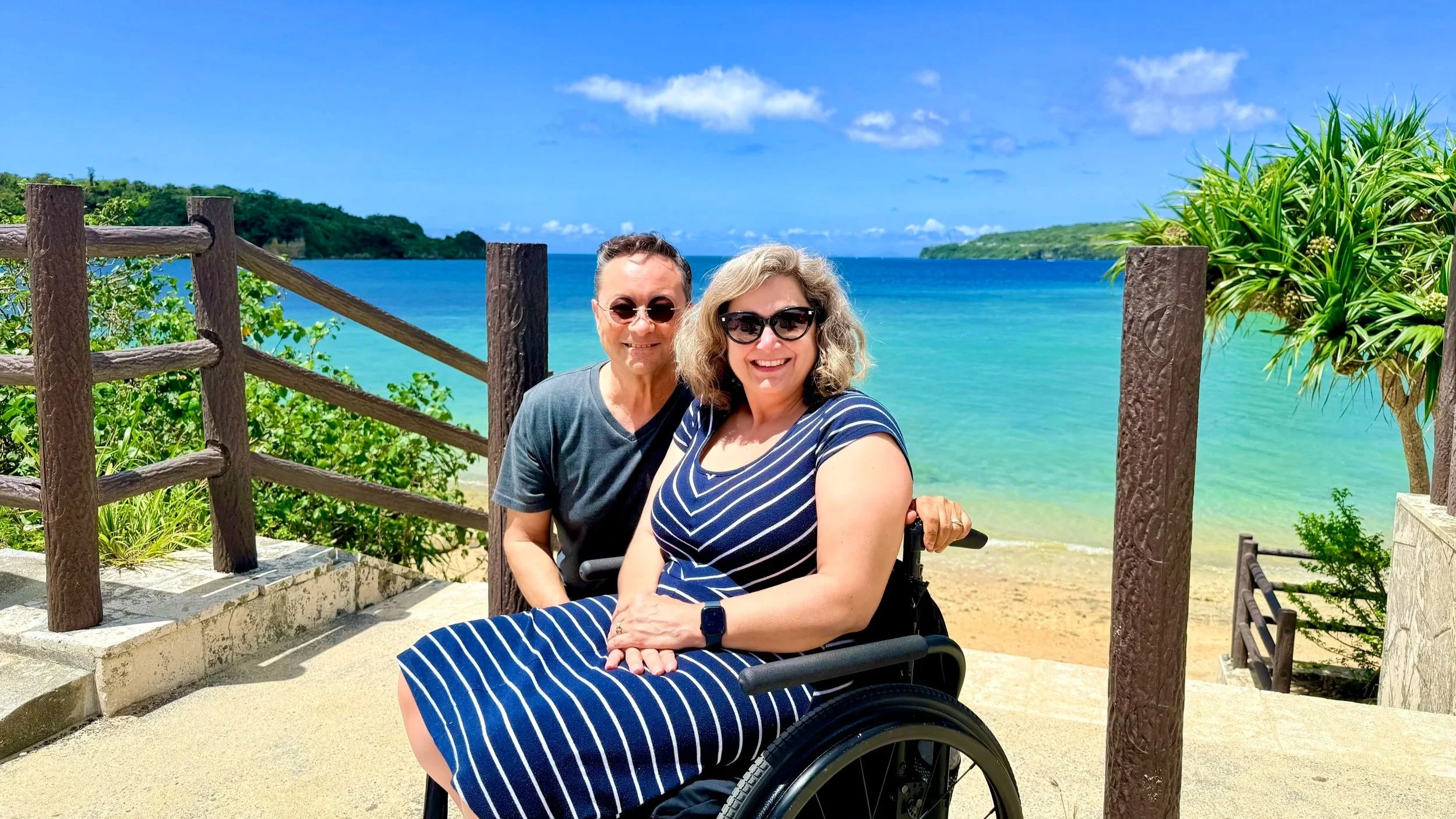
This is the color the water in Okinawa actually is: turquoise up to the sand, deep blue out between the headlands.
Everyone we met was proud to be Japanese. They were just as proud to be Okinawan, and they did not appear to think those were the same thing.
We have been to Japan many times and we arrived expecting a southern version of it, warmer and slower and otherwise familiar. What we found was a place that spent 450 years as a kingdom of its own, trading with China and Korea and Southeast Asia, and only became a Japanese prefecture in 1879. The Japanese layer is real and it is everywhere. It is also the newest thing on the island.
The rule-following that runs the mainland is still here, slightly loosened. People call this the Hawaii of Japan and we understand why, though the comparison undersells how Japanese it still is.
The geography explains more than the guidebooks do. Naha sits about 390 miles from Taipei and about 970 from Tokyo. The prefecture's own list of international routes runs to Taiwan, Korea, China and Hong Kong without a single American city on it. This island has always looked south and west. The kingdom did, and the airport still does.
And then there is the war. The Battle of Okinawa ran 82 days in the spring of 1945 and killed roughly a third of the island's civilian population. The American presence never left. Okinawa is less than one percent of Japan's land and carries more than seventy percent of the land the US military occupies in the country, which is the prefecture's own accounting. That is an unfair share of the burden for one small island to carry.
Who should skip it: anyone whose picture of Japan is temples, castles and a particular kind of food. You will find versions of all three here and they are not the versions you came for. Who should go: anyone who wants a beach trip without leaving Japanese culture to get it, and anyone who already loves Japan and wants to understand what the edges of it look like.
The Hotels
The Hotels
Start with the honest part. Okinawa has few hotels in the top tier, and we stayed at one and entered no others. What follows is one firsthand verdict and then a map, because on this island the harder question is not which hotel but which coast.
The island is bigger than it looks and it is long. Naha and the airport sit at the southern end. The resort strip runs up the west coast through Onna, roughly an hour from the airport. The far north, past Nago, is where the aquarium is and where the island empties out. And the public transport that makes the mainland easy does not exist out here, so picking a base is picking how many hours of your week you spend in a car.
Halekulani Okinawa: Our five nights, in Onna, on the water. It holds two Michelin Keys, the only hotel on the main island with that rating, and Forbes rates both the hotel and its spa at five stars. We are giving it a full review of its own in this issue, so the detail lives there.
The thing worth saying here is about its address rather than its rooms. It is not in a town. That is most of its appeal, and it is also the cost: there is no walking out the door to dinner, and without a car or driver you are on taxis for everything. If you want a resort to be a resort, this is correct. If you want to wander out and find a noodle shop, book somewhere else.
The Ritz-Carlton Okinawa: In Nago, further north, on a golf course above Kise Bay. One Michelin Key. We did not go in. We are naming it because it is the only globally familiar American luxury flag on the island, which matters to readers who book on brand, and because its position puts the aquarium within easy reach in a way Onna does not.
Four smaller Japanese houses hold a Key each and are what we would look at next time, none of them internationally branded: HOSHINOYA Okinawa at Yomitan, The Hiramatsu Ginoza on the east coast, One Suite THE GRAND at Nakijin near the Kouri bridges, and Hyakuna Garan in Nanjo, the only one that puts you near the war memorials.
Two large resorts sit near Halekulani in Onna, The Busena Terrace and ANA InterContinental Manza Beach. Neither holds a Key and neither is trying to be a luxury property in the sense this article means. They are good hotels in a beautiful place and they cost considerably less. Being told that plainly beats being sold a tier.
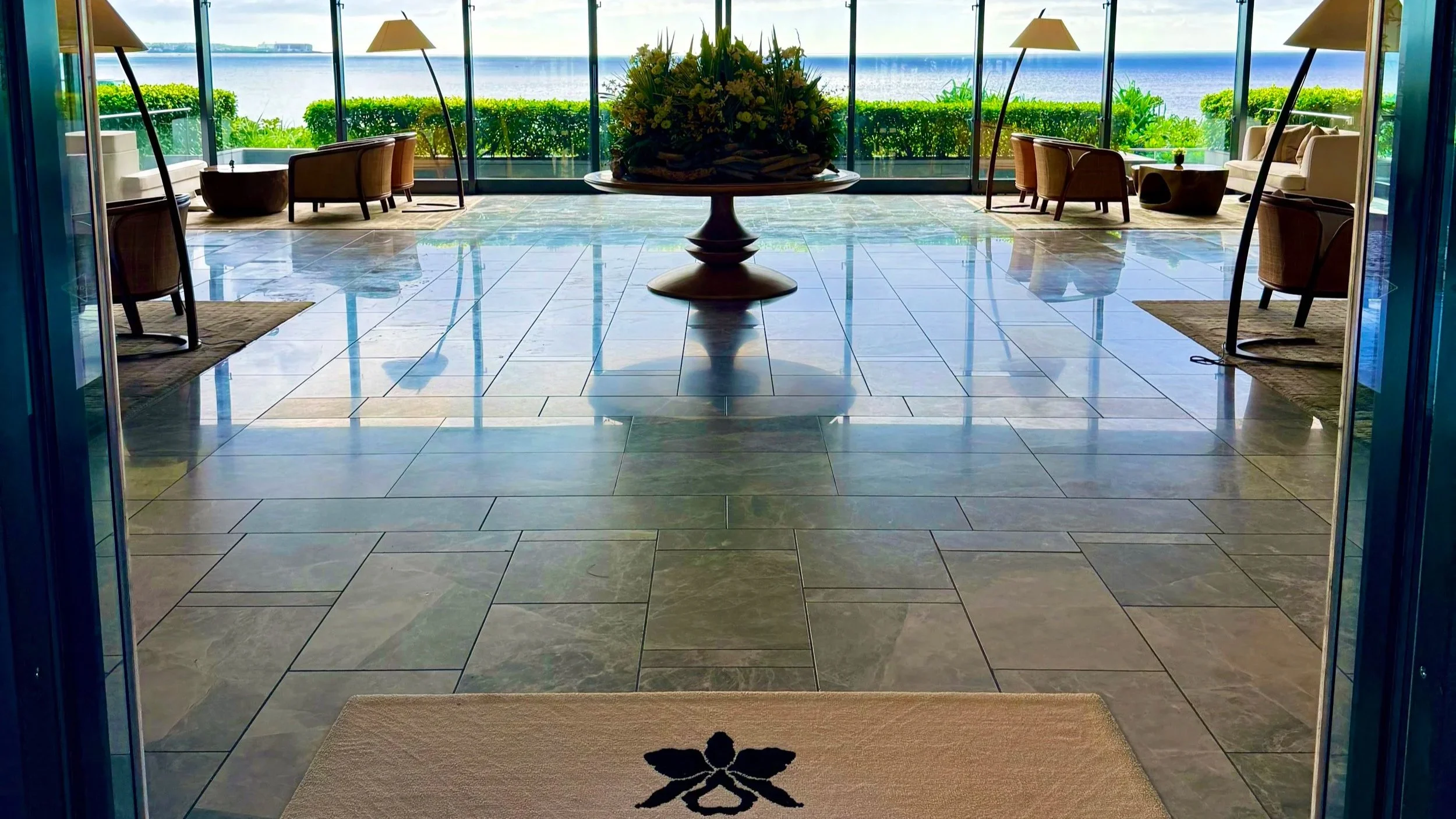
From the front doors of Halekulani Okinawa, the lobby runs on one level all the way to the glass, with the East China Sea beyond it.
The Dining Scene
Our hotel meals belong to the Halekulani review, so this is what we ate off the property, and we had the island's food wrong before we came. We expected fish. Okinawa is a subtropical island in the Pacific and we assumed the plate would look like it.
It is pork. The local phrase for the cuisine is that it begins with pork and ends with pork, and nearly every part of the animal has a dish built around it. The reason is the kingdom, which hosted Chinese delegations of four or five hundred people for months at a stretch and got through about twenty pigs a day feeding them. Pig farming expanded to keep up. A trade route turned into a dinner.
Kuon: Omakase in Naha, and the single best meal of our trip. Twelve courses, five of us at the counter, one chef and an assistant working in front of us for two and a half hours. The menu is seasonal and changes constantly, so what we ate is not what you will eat. That is the point of it. One course was a small freshwater fish in a light tempura batter, gutted and otherwise whole, eaten head, tail and bones together. We had never eaten bones before. The crunch was good. Getting past the fact that we were eating a whole fish was the harder part, and the one course we did not finish. Watching that made at the counter rather than delivered is half of what you are paying for. Precision without any showmanship. Well worth booking.
Beef Soup: Ushijiru, which we had twice and would have had a third time. Beef simmered with carrot and kombu in a bonito broth, finished with grated ginger, kept clear and light rather than heavy. It is a quiet dish on an island of loud ones. It is also an outlier. Cattle worked the fields under the kingdom and were not raised to be eaten, so beef never became everyday food here the way pork did.
Rafute: The pork belly, skin on, simmered for hours in bonito stock, awamori, sugar and soy until a chopstick goes through it. Dark and glossy and more sweet than we expected. This is the dish the island puts on the table for celebrations and it earns the spot.
Goya Chanpuru: The one that lost us. Bitter melon, sliced into half-moons and stir-fried with island tofu, pork and egg, and it is the signature Okinawan dish in the way a thing can be beloved locally and still not land for a visitor. We tried it. The bitterness carries the dish rather than accenting it, and we could not get past it. We also understand that saying so marks us as tourists, and we are at peace with that.
Blue Seal: The ice cream chain, and not the American import it looks like. We kept passing shops done up as American diners, checkerboard floors and red leather, and assumed it was a theme. It is not. Blue Seal began in 1948 as a dairy under contract to the US military and did not sell to Okinawans until 1963. Its own slogan is "Born in America, raised in Okinawa." The decor is not a costume. It is the company's actual biography, and the ice cream is very good.
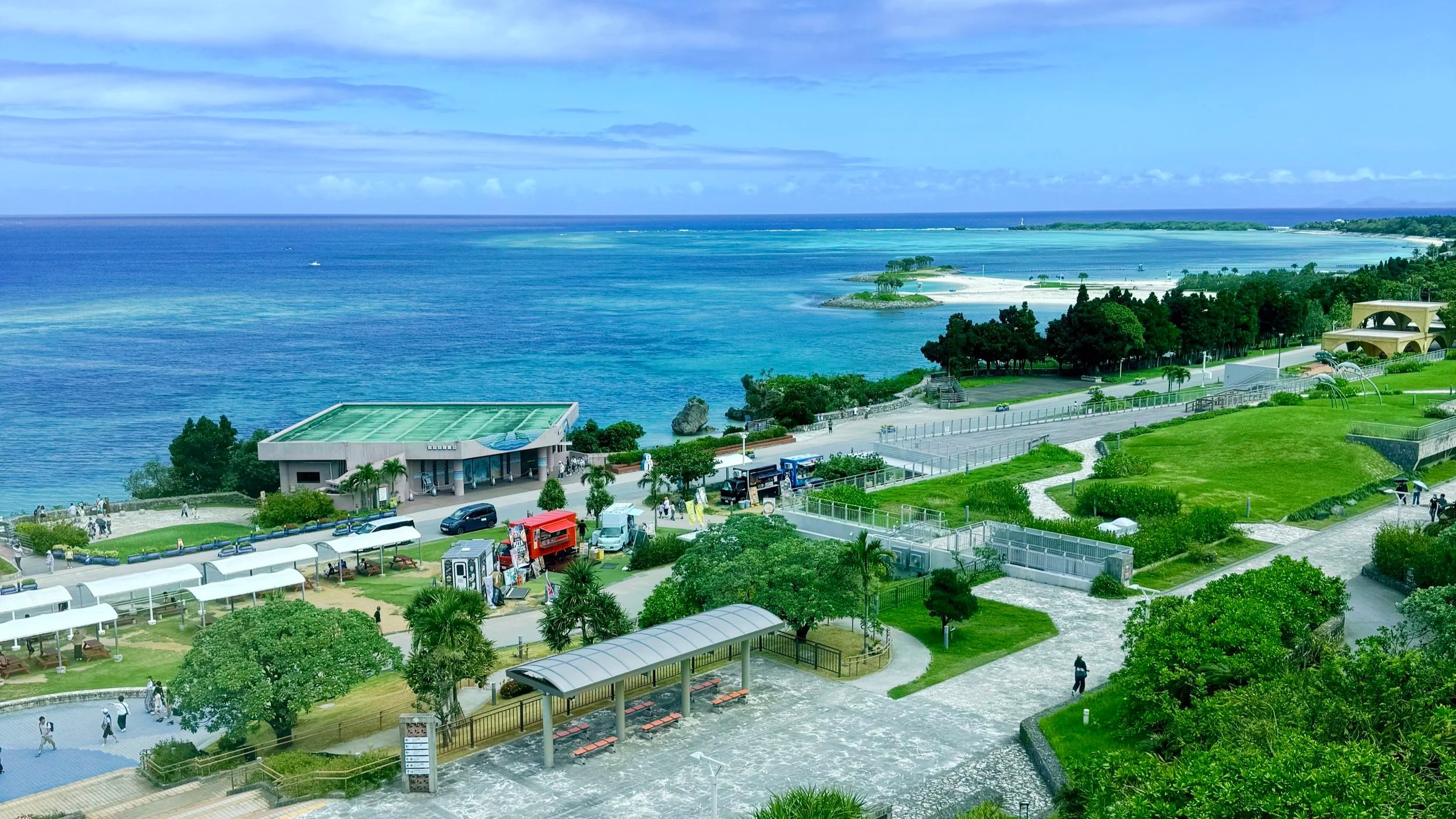
The beach and gardens at Ocean Expo Park are free; only the aquarium charges admission.
What to See
Okinawa Churaumi Aquarium: Worth the drive, and the drive is real, roughly two hours north from Naha. Go for the whale sharks. They are the reason the place is famous, and only a handful of aquariums in the world hold them. The size of them is only half of it. The tank is big enough to hold them alongside everything else, so you are watching something that large move through traffic. We stayed at the acrylic for half an hour on one fish and never thought about moving on. One of them, Jinta, has been there since 1995 and has roughly doubled in length in that time.
The aquarium would be worth it without them. Give this visit more time than you think.
Ocean Expo Park: The aquarium sits inside it, and the park is free. That is not a technicality. You pay for the aquarium and everything else is open. The sea turtle pool is the one that caught us, several species in an open-air pool with an underwater viewing room below. There is a manatee pool, a dolphin theater and a beach, all free. And the whole thing is on the coast, so you come out of a dark aquarium into a view that stops you.
Shuri Castle: We saw it and did not tour it, and the reason was time rather than judgment. We will go in next trip, because the reconstructed main hall opens to the public on 23 November, after the rebuild from the 2019 fire. Entry is by timed advance reservation, so if you are going after that date, book the slot.
What we could see from outside is that this does not look like the castles we know from the mainland. It sits on a hill behind long limestone walls that curve with the ground instead of cutting across it, and the palette is vermilion and red tile rather than white plaster. Inside the walls there are open plazas and sacred groves, which is a Ryukyuan idea rather than a Japanese one.
The Himeyuri Monument: The one we would not skip. More than two hundred schoolgirls and their teachers were mobilized as nurses in the final weeks of the battle, and the monument stands directly on top of the cave where most of them died. You can see the mouth of it from the path. Nobody goes in. The museum behind it tells the story through the survivors' own testimony and a full-size reconstruction of the cave, without a trace of sentimentality, which is why it works.
The Okinawa Prefectural Peace Memorial Museum: At Mabuni, in the south, where the battle ended. We think every American should see it. The museum itself is unsparing and the Cornerstone of Peace outside it is the thing we keep describing: stone walls carrying the names of everyone who died in the battle, of every nationality, with no separation between soldiers and civilians, and well past two hundred thousand names. Okinawan dead are inscribed even where no name survived, identified by their relationship to someone who was known, because the records burned.
It rained the day we went and we cut the outdoor part short. That is our one real regret from the week.
The Kouri Bridge: Up at the northern end, and the water under it is a color we did not believe until we were out over it. The bridge runs just over 6,400 feet between two small islands, Yagaji and Kouri, which you reach from the main island over a second bridge. We stopped at the lookout on the Yagaji side, at Sumuide, which is where to park.
Beyond Okinawa
Taiwan, and we mean it as a practical suggestion rather than a flourish. We flew in from Taipei on this trip and the hop is shorter than most flights inside Japan.
We wrote about Taipei last month, so we will not relitigate it beyond saying the two pair unusually well. Okinawa is slow, green and thin on things you must see. Taipei is dense and fast and one of the most accessible cities we have been to. A week split between them is a better trip than two weeks of either, and the connecting flight costs less than most domestic hops inside Japan.
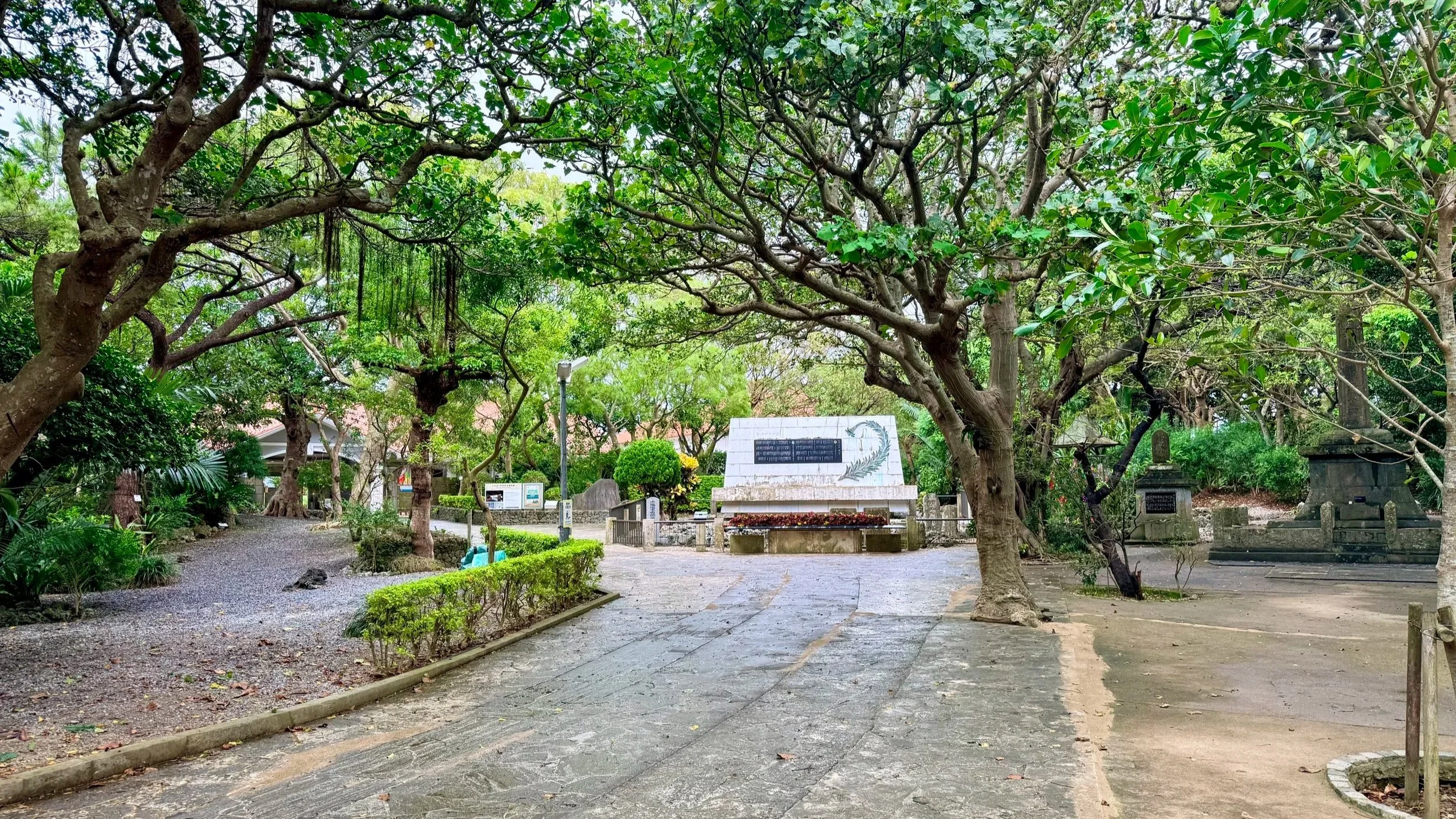
A shaded path leads to the Himeyuri Monument, which stands over the cave where most of the student nurses died.
What Stayed with Us
The people, and we are aware of how that sounds.
Japanese service is famous and deservedly so. It is precise and attentive and it runs on a kind of professional care that never slips. We have written admiringly about it for years. What we met in Okinawa was that same standard with something else underneath it, less performed and more personal, closer to how you are treated on an island where everyone knows the ferry schedule.
We cannot put it more exactly, and we have tried. It is the reason we would go back, ahead of the aquarium and ahead of the food. A place where the service is excellent is a place you enjoy. A place where the people are warm is a place you want to return to, and plenty of places manage the first without the second.
Our Favorite Discovery
Okinawa soba, and the reason it tastes nothing like soba.
It contains no buckwheat. None. The noodles are wheat flour worked with alkaline water, which makes them ramen noodles by every technical measure, served in a pork and bonito broth under braised pork belly, fish cake and pickled ginger. They are thicker and chewier than anything the word soba should produce, and after the first bowl we stopped trying to file it against something we already knew.
Japan's Fair Trade Commission noticed the same problem in 1976 and objected that a product with no buckwheat in it could not legally be sold as soba. The proposed replacement name was Okinawa-style Chinese noodles. The island fought it, and in 1978 they won the name back on the condition it only be used inside the prefecture. They still mark the day.
We had it several times and could have eaten it every day. What it reminds us of is ramen, not the soba we know.
Accessibility
Good, not great, and the gap between those two words is the whole story here.
Okinawa has no comprehensive rail network. Mainland Japan has spoiled us: in Tokyo every subway station has a step-free route from street to platform, and we move through that city more easily than most American ones. Okinawa has a short monorail in Naha and otherwise you are on the roads. We had an accessible van and a driver for most of the week and it was money well spent. Without one you are looking at a lot of taxis, and the distances are longer than the map suggests, with some transfers running to several hours.
The public sites were uniformly excellent, as we have come to expect in Japan. The aquarium, Ocean Expo Park, the Peace Memorial Museum and Shuri Castle are all properly accessible, with working elevators and loaner wheelchairs, and several of them waive admission for disabled visitors and a companion.
Restaurants are where it gets harder, and it is the same problem as the mainland. The good small places are small and old, and a step or two into the entrance is common. Everything was doable. Almost nothing was effortless, and you should plan on asking before you arrive.
Two specifics worth carrying. At the Kouri bridge, the span has a ten-foot sidewalk running its full length, so you can get out over that water properly rather than looking at it from a parking lot. The path down to the beach below the lookout is stairs only. And at Halekulani there were no pool lifts, which is common outside the US and still disappointing at this level.
At Urasoe Dai Park, just north of Naha, there is a wooden observation deck at the top of the hill, and somebody built a switchback ramp up to it so that a wheelchair can reach the view. It is not a token gesture, and nothing marks it. The park's own website does not mention it at all. We found it because we were there.
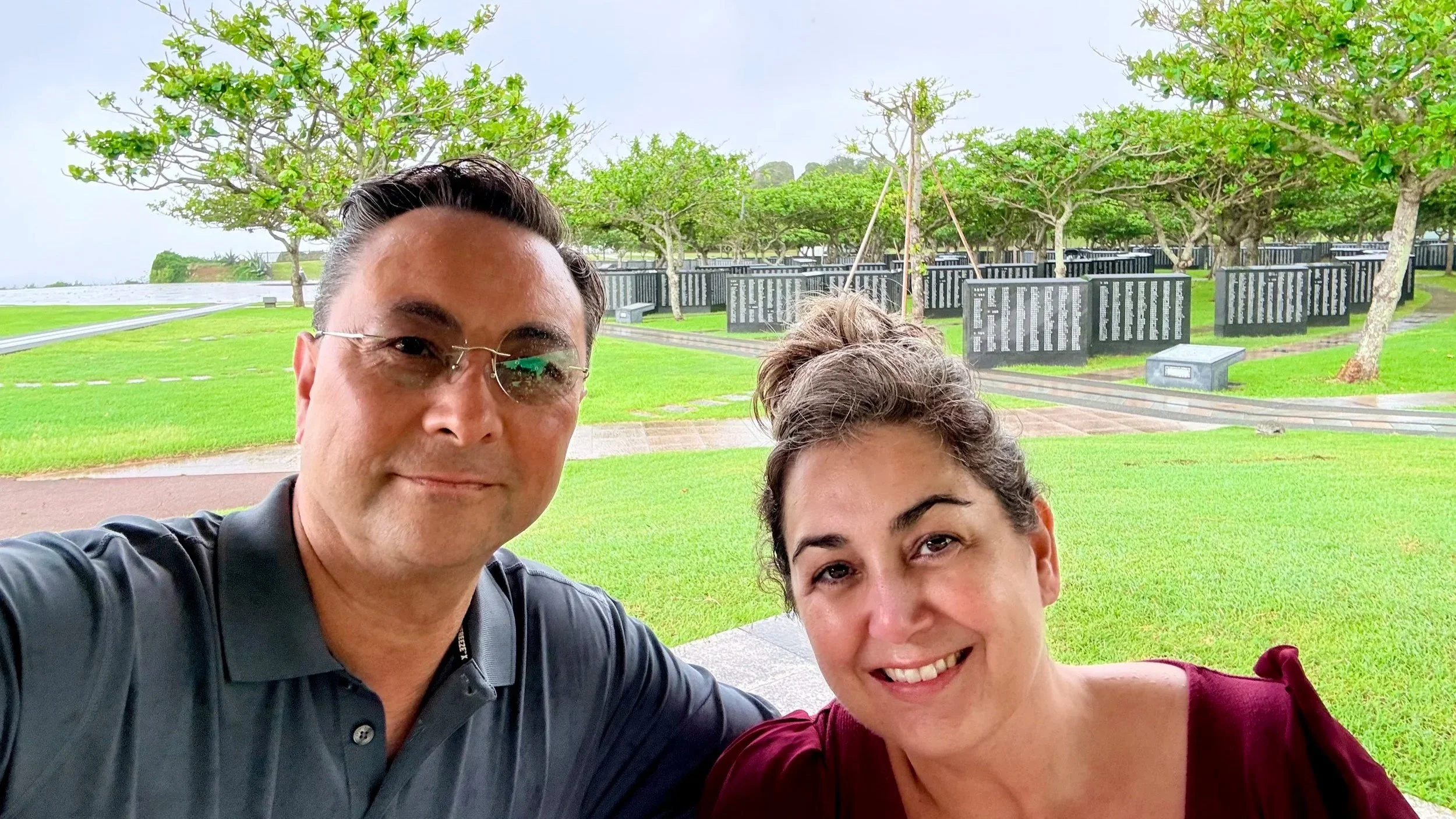
It rained the day we reached the Cornerstone of Peace at Mabuni, where the walls carry the names of everyone who died in the Battle of Okinawa, whatever side they were on.
The TudorTravels Perspective
Okinawa is for travelers who want to slow down inside Japanese culture rather than tour it. It is Japan with tropical water and beaches, and it is hard to see how that goes wrong. If your last Japan trip was Tokyo and Kyoto and you want the next one to be different without being somewhere else entirely, this is the answer. If you need a skyline, a temple circuit or the food you already love about Japan, you will spend the week mildly disappointed and it will not be the island's fault.
Give it five to seven days and base yourself on the west coast. You will spend real time in a vehicle either way. Southern Okinawa deserved more than the single rainy afternoon we gave it, and that is what we would change.
Getting there is about to get easier. United begins nonstop San Francisco to Naha on 27 March 2027, three times a week, and it will be the only US nonstop to Okinawa. Read the dates, because it is a summer route: the last southbound flight is 28 October 2027, and a winter trip still connects through Tokyo or Osaka. STARLUX brought us over and China Airlines took us back, and both were a pleasure in a way that US domestic flying has taught us not to expect.
We came for a beach week attached to a bigger trip. We left understanding that we had spent six days in a place that had been a different country, and we had barely touched it.
Inspired by Okinawa or Japan? Contact us to plan your time there, or anywhere else in Asia you want to explore.