
New Delhi, India

Getting around Delhi, with a driver who made it look easy, threading gaps we would never attempt. As an American, driving in India is not something we recommend. Get a driver!
We have been to Delhi three times now, ten nights total, three of them with our daughters and son-in-law on this last trip, and every time it surprises us in the same way. You brace for chaos and smog. What you get, if you time it right, is green.
The traffic is the first shock, and no amount of reading about it prepares you. Lane markings are a suggestion. Intersections run without lights or signs, because a stop sign is apparently not really a thing here. And yet we watched cars thread through packed junctions at speed, missing each other by inches, without a single collision the whole time we were there. It should not work. It works anyway, cars finding gaps the way water finds a path downhill, and somehow motorcycles, scooters, hand carts, pedestrians, and the occasional cow all get folded into the same moving system. We came in expecting Delhi to be the hardest stop on an India trip. It turned out to be the easiest of everywhere else we have been in the country, and the parks alone made us reconsider the whole city. We had pictured haze. We got blue sky, and grass, more of both than any Western friend has ever believed when we describe it.
The Hotels
We have stayed at five hotels across our visits, and they split cleanly into two kinds of stay: the ones we would return to without hesitation, and the ones that are fine for a night near the airport and nothing more. These are all city hotels, not resorts, so none of them will overwhelm you the way a beach property might. What they do instead is stay supremely comfortable, night after night, with food that punches well above what a city hotel usually bothers with.
The Oberoi, New Delhi: This one has hosted us three times, and it is the property we measure every other Delhi hotel against. The building sits behind its own grounds, so the first thing you notice checking in is how much green surrounds a hotel in the middle of a capital city. The service is where Oberoi actually separates itself. We have stayed at Oberois across India now, and the New Delhi property has never once let a request go unnoticed, never made us ask twice. The breakfast buffet belongs in the same conversation as the best hotel breakfasts we have had anywhere in the world, and we do not say that lightly.
The Oberoi, Gurugram: We have been back twice, and we book this one for exactly what it is not, centrally located. Gurugram sits outside the city, which sounds like a downside until you need it to be true. A first or last night out there can cut real time off an airport run, or off the drive to wherever the next leg of a longer trip is heading. It carries the same standard of care as its sister property, the same instinct for noticing what we needed before we asked, so choosing it for logistics does not mean giving up on the experience.
The Andaz Gurugram: Same purpose, one notch down. We tried it once on a tight connection, and it did exactly that job well. If a night inside Delhi itself matters more to your day than shaving time off a transfer, book one of the others instead.
The Imperial: We have stayed here twice, and it works on us in a completely different way than the Oberois do. Where the Oberoi properties are about flawless modern service, the Imperial is about walking into a piece of history that has not been sanded down to please anyone. The lobby and public rooms still carry the weight of the colonial and Indian eras sitting side by side, and the hotel leans into that rather than apologizing for it. We did a tea sommelier session there, a server walking us through a tasting flight and explaining where each leaf came from and how it was processed, and we came away actually understanding something about tea we had been drinking blind for years. The Imperial is also home to the Spice Route, a restaurant divided into nine sections that trace the historic Asian spice trade from Kerala through Southeast Asia, each room hand painted and built around its own stretch of that route. If you want to feel like you are standing inside British and Indian history at the same time, this is the address that gives you that.
The Lodhi: This is where Indian Accent lives, and dinner there is as close as we have gotten to the hotel itself. So this is not a review: the rooms are basically all suites, huge by any city hotel's standard, and most of them come with their own private plunge pool. The whole place reads more residential than hotel, sleek and modern rather than palatial. It is on our list for an actual stay next time.
Across all of them, the accessible room situation was better than we have found in most countries we have visited, which we did not expect given how much the streets outside can ask of a wheelchair. These are luxury hotels doing what luxury hotels are supposed to do, and inside their walls, at least, Delhi is easy.
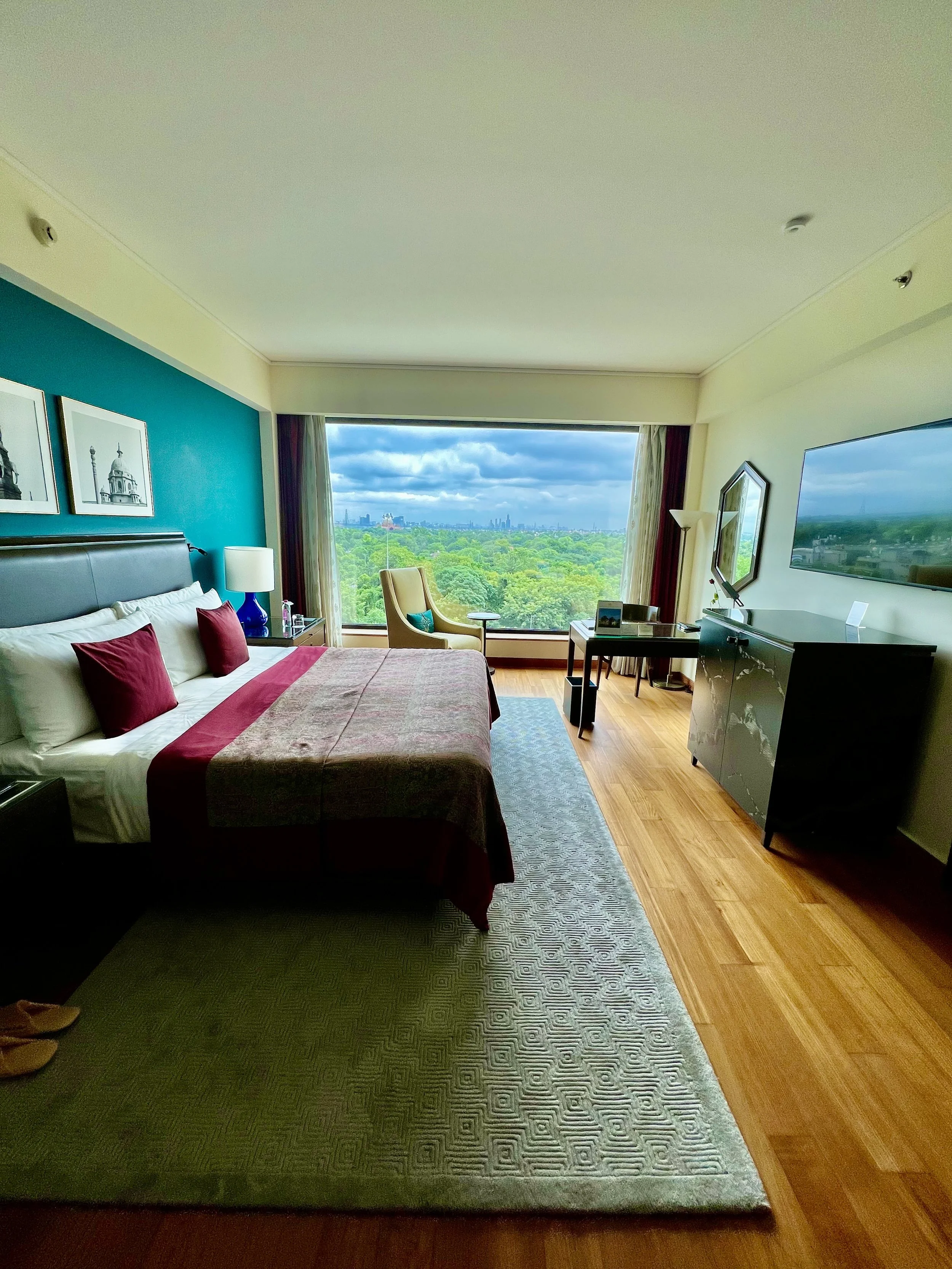
The view from the Oberoi New Delhi room, in the heart of the city, that broke our assumptions about Delhi being brown and hazy all of the time.
The Dining Scene
Delhi eats like a city that takes food as seriously as any capital in the world, and the range runs from decades-old classics to the kind of casual strip where you eat somewhere different every night without ever landing on a bad meal.
Dum Pukht: The one to book for biryani. The dish is slow cooked and sealed under dough so none of the steam escapes, and what arrives at the table is one of the best we have eaten in India. The room matches the food, ornate without tipping into excess, and it is worth going for the setting even before the plate arrives.
Indian Accent: Inside the Lodhi, and it carries the reputation of being the best Indian restaurant in the city, with a sister location in New York that trades on the same name. We went in with high expectations and left thinking it was very good rather than the best meal of the trip. Excellent food, no argument there. Just know that the reputation runs slightly ahead of the experience, and go in with that calibration rather than expecting a religious experience.
Havemore Bar and Restaurant: The one we would send you to first if we could only pick one. The butter chicken here is the best we have had anywhere in India, richer and better balanced than the version most people know from home, and it alone is worth the trip across town. We have gone back on more than one visit just for that dish.
Connaught Place: Less a single restaurant than a neighborhood of casual options, and we have eaten there every visit without a disappointing meal. It is the easy answer on a night when you do not want a reservation and just want to wander until something smells right.
Dhilli: Inside the Oberoi, and the one honest gap in our own coverage. We did not eat there ourselves. The restaurant it replaced was one we had enjoyed on an earlier stay, and by the time we returned it was gone, Dhilli in its place. Everything we have read says it is even better than what came before, so take this as a strong recommendation on reputation rather than our own verdict.
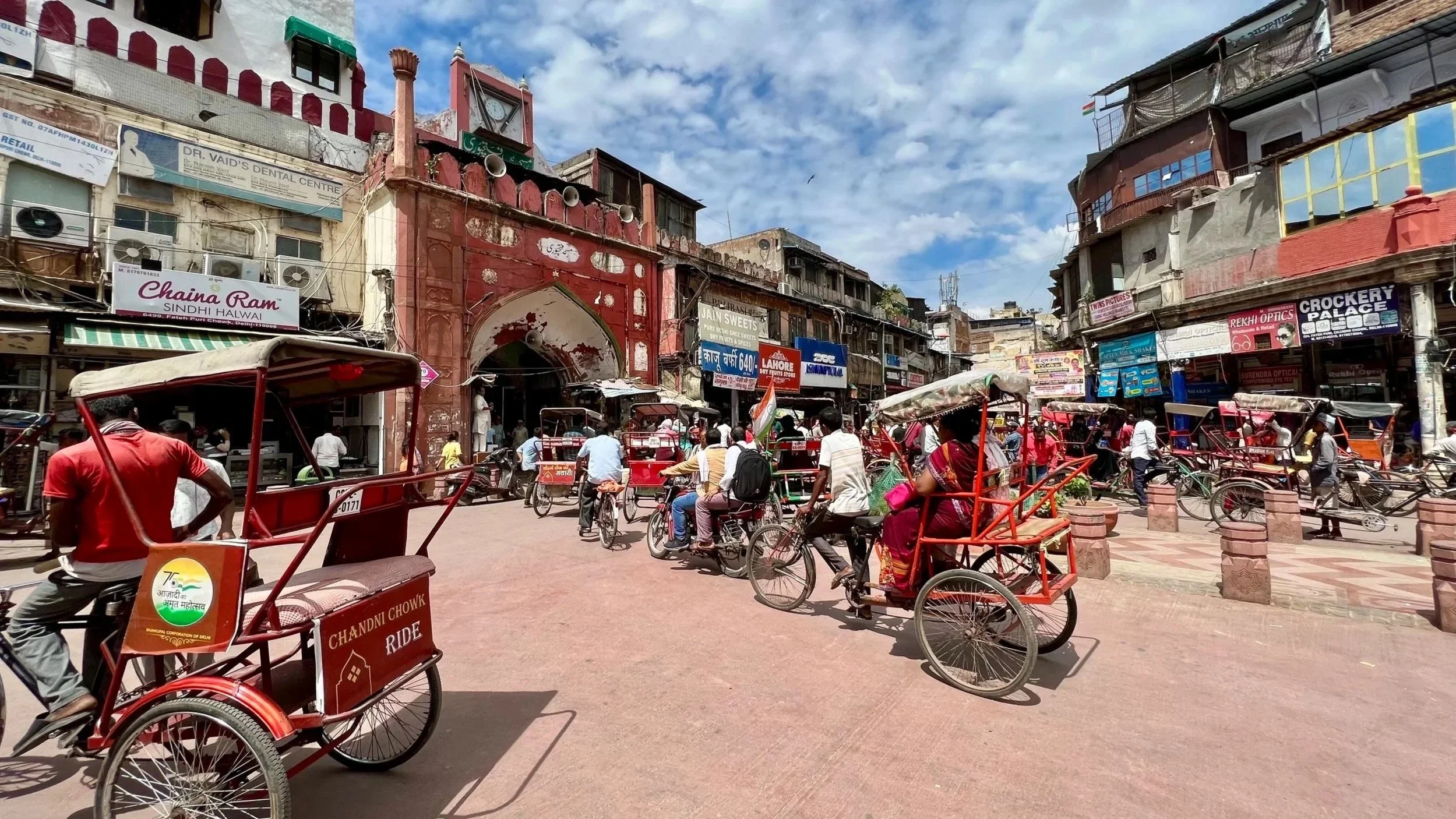
This is how you see Old Delhi, a car does not fit down most of what comes next. Our rickshaw driver earned every rupee, and then some.
What to See
Delhi's sightseeing splits into two very different experiences, and both deserve real time.
The Classic Monument Circuit: Worth doing in full, and we have covered all of it across our visits, the Red Fort, Qutub Minar, Humayun's Tomb, India Gate, Akshardham, and the Lotus Temple. Each earns its place on the list. None of them is the reason we keep coming back.
Lodhi Gardens: The parks are the real reason to slow down here, and this is the one to build a morning around. Ninety acres in the middle of the city, fifteenth-century tombs scattered through the grounds, and it is not a tourist stop dressed up as a park. Delhi residents run and walk here every morning, the same as any city park anywhere. Except this one has a five-hundred-year-old dome sitting in the middle of the jogging path.
Sunder Nursery: Right next to Humayun's Tomb, ninety more acres and over three hundred species of trees, close enough to a proper botanical garden that we would call it exactly that. Pair it with Lodhi Gardens on the same morning and you get a full loop of tombs and trees without ever leaving the same stretch of the city.
Old Delhi: Its own world, and the way to see it is by bicycle rickshaw, which we did, weaving through lanes too narrow for a car. Those drivers work harder for their money than almost anyone we have watched on a trip, legs pumping through crowds that never quite part for them. We stopped at spice shops piled with color we could smell before we saw, bought more than we needed, and visited the Shri Digambar Jain Lal Mandir, a working temple tucked into the middle of the market chaos. Chandni Chowk, the old market strip, is the street food capital of the city, and it earns that title honestly.
Hauz Khas Village: It runs on two different clocks. By day it is a thirteenth-century fort and reservoir, quiet ruins you can wander with almost nobody else around. By night the same lanes fill with rooftop bars and a completely different crowd, and the contrast is worth experiencing on its own, ideally on the same day so the shift actually registers.
Agrasen ki Baoli: The one almost nobody mentions, and it should get mentioned more. A fourteenth-century stepwell a few minutes from Connaught Place, free to enter, and nearly always empty. Most visitors walk right past the entrance without noticing it is there, which is most of why it stays this quiet. Step down into it and the noise of the city disappears almost immediately, replaced by carved stone walls running deep underground and a stillness that feels out of place this close to the middle of the city.
Gurudwara Bangla Sahib: The single thing we would tell anyone not to miss. The Sikh temple runs a kitchen that serves free meals to anyone who walks in, more than thirty thousand people on an ordinary day, every day of the year, and almost the entire operation runs on volunteers. We toured the kitchens themselves, the scale of it hard to process even standing inside it, and on this trip our daughters actually joined in and helped serve one of the meals. Watching them ladle food alongside people who show up and do this work for no pay, day after day, told us more about how this city actually runs than any monument did.
Beyond Delhi
A Day in Agra: The Taj Mahal is the obvious answer, and it is an easy one. A modern, multi-lane expressway now runs the length of the route, built specifically to connect the two cities, and it makes the drive easy and fast, a different trip entirely from the older road through town after town that used to turn this into a full day before you even reached the monument. That difference is what makes Agra a real day trip from Delhi rather than an overnight commitment. Leave early morning, be at the Taj by late morning, and you are back in Delhi in time for dinner.
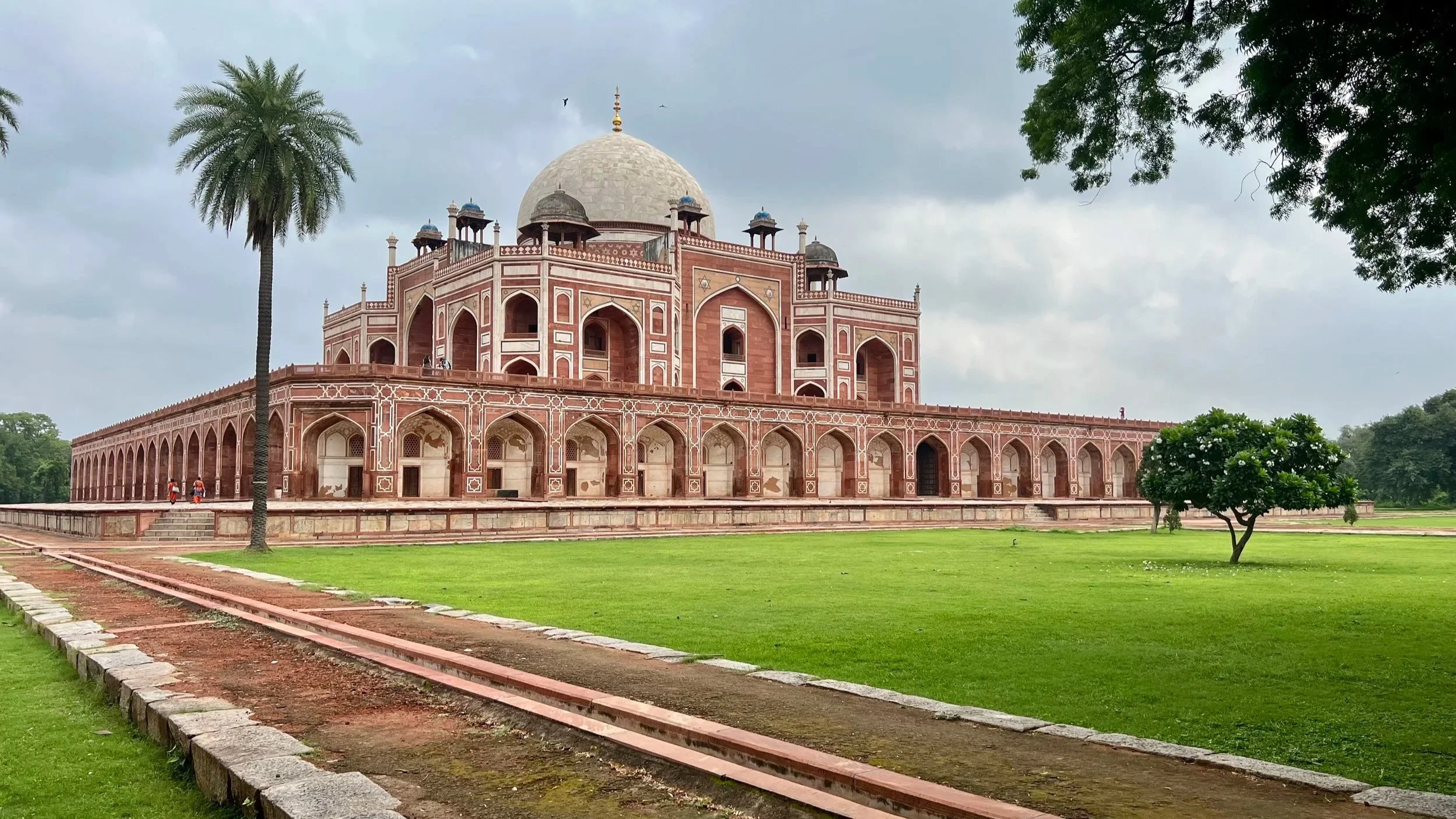
Nobody warns you that Delhi has this much green, or that you might have it almost to yourself.
What Stayed with Us
What stayed with us most happened at a table that is not in any listing anywhere. We have used the same tour operator, Travelscope, on all three of our India trips, and they have gotten every detail right every time. On this one they arranged for us to spend an evening at the home of friends of theirs. They cooked an entire meal from scratch while we watched and asked questions, and by the end of it we understood more about Indian cooking than years of eating in restaurants had taught us. Then we just talked, about life, about the differences between where we come from and where they live, no agenda beyond two families getting to know each other for one evening. It stands at the top of our list of trip highlights anywhere, not just in Delhi, and the food alone would have made it memorable.
That same warmth showed up in smaller ways everywhere we went. Delhi is a city of contrasts everywhere you look, glass towers a few minutes from families with nothing, centuries-old stone next to construction cranes, and somehow the food carries that same range. Judy is pescatarian, and in most places that means the kitchen simply removes the meat from a dish built around it and calls it done. In Delhi it meant something else entirely: dishes built from the ground up to be vegetarian, a whole separate tradition rather than a subtraction, layered with as much flavor as anything with meat in it. She ate better here than in almost any city we have been to. Add the parks we kept stumbling into, one after another, and the whole trip stopped resembling the Delhi either of us had pictured before we landed.
Our Favorite Discovery
We came home with two this time and could not choose between them, so here are both.
Masala Chai: We drink coffee everywhere else we travel. In India we do not touch it, because masala chai is simply better, and once we started ordering it on the first trip we never looked back. Some stalls make it better than others, but we have not had a bad cup in the country yet. We have tried recreating it at home more than once, and it never comes out the same. Whatever happens on the stove there does not travel.
Mango Season: This one came from timing the trip for May and June, and it changed how we think about the fruit entirely. India grows close to a thousand mango varieties, and peak season stacks several of the best ones in the market at once. We ate our way through more kinds than we could keep straight. Nowhere else does mango like India does.
Accessibility
Delhi is not the most accessible city we have been to. The infrastructure has real gaps, curbs and stairs and stretches where a wheelchair was clearly never part of the plan. What closes that gap is the people. On one trip, the ramp our usual vehicle uses did not fit right, and our Travelscope driver had a new one built overnight to fix it. More than once, when a flight of stairs was the only way up, people simply came over and carried Judy, wheelchair and all, to get her there. That is not a comfortable thing to have happen to you, being lifted by strangers, and we will not pretend it is. Where the infrastructure has not caught up, the willingness of the people around you does the job instead.
Old Delhi is the hardest part of the city itself. The lanes there are tight and crowded, narrow gaps never built with a chair in mind.
Away from the old city, it gets easier than we expected. Most of the major monuments and the parks we visited were navigable without major issue, more accessible than we had assumed going in. The Delhi Metro looked well designed for accessibility when we went down to look, ramps and lifts at the entrances we checked. We did not ride it ourselves, because the platforms were crowded enough that we were not confident about a smooth boarding, so we cannot vouch for the actual experience of getting on a train, only for what the infrastructure appeared to offer.
The hotels are where accessibility was best handled by a wide margin. Every property we stayed at gave us an accessible room that felt considered rather than bolted on as an afterthought, which is not something we can say in every country we have visited at this level. The rest of India asks more of a wheelchair user than Delhi does, so do not read this section as a verdict on the whole country, only on the capital.
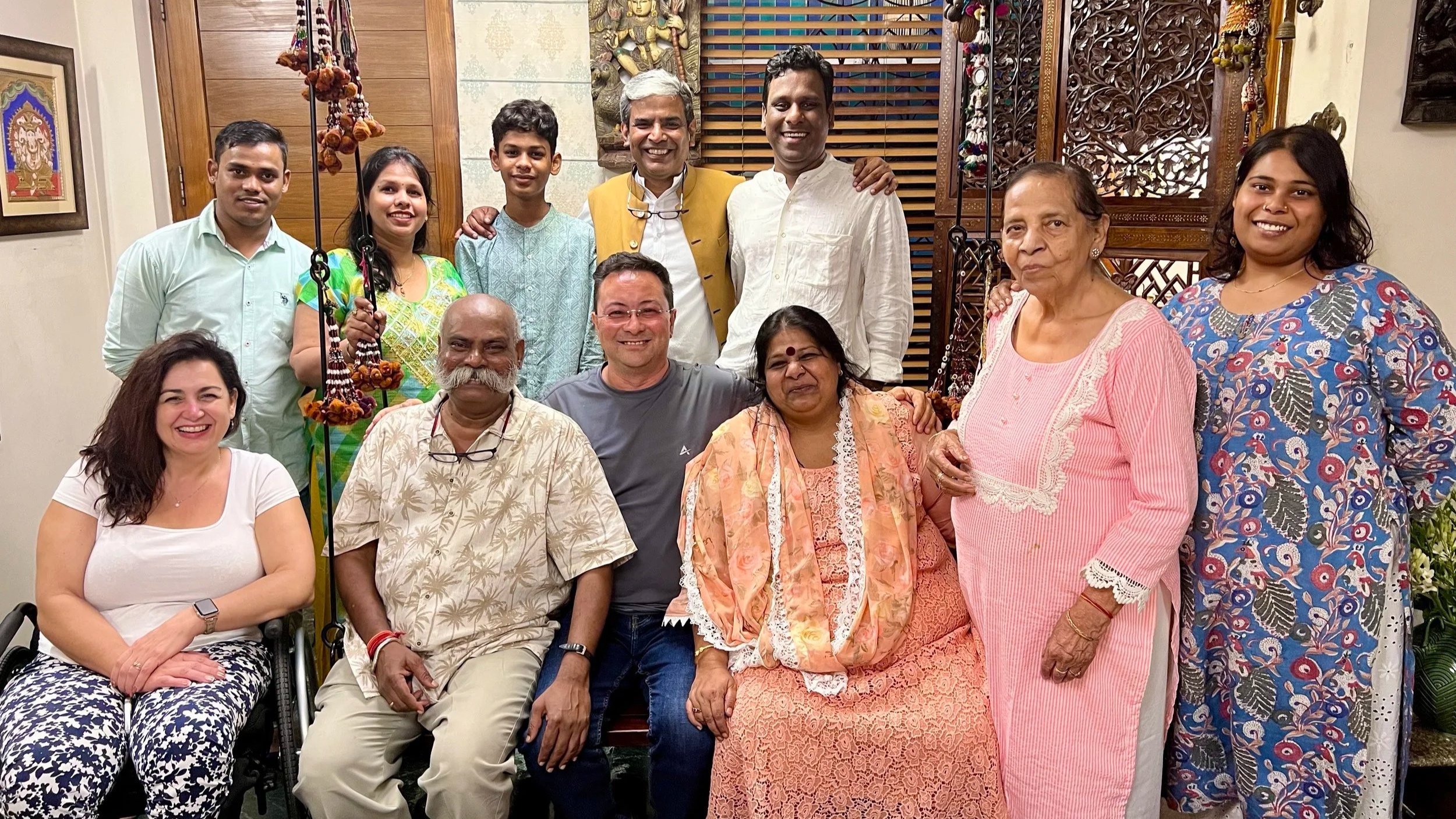
On our first trip to Delhi we spent an evening in a private home, watching the family cook the whole meal from scratch. The food and the company were the absolute highlight of our Delhi visit.
The TudorTravels Perspective
Delhi gets treated by a lot of travelers as the airport you land at before the real trip starts, a stop to survive on the way to Agra or Jaipur. After three visits, we do not think that holds up. The parks alone are worth restructuring an itinerary around, and the food scene rewards more time than a single dinner between flights.
It works best for travelers who want their history with some noise and unpredictability mixed in, rather than a city that has smoothed every edge for visitors. If you want a destination that runs on a fixed schedule, this is not it. The traffic alone will test that kind of traveler daily. But if you can hand yourself over to a system that looks like chaos and somehow is not, Delhi rewards you with more warmth, more green space, and better food than its reputation abroad gives it credit for.
We would build a Delhi stay to three or four nights rather than one, use the Yamuna Expressway for an easy day at the Taj, and trust the city to surprise you the way it has surprised us on every visit.
Inspired by Delhi? Contact us to plan your time there, or anywhere else in India you want to explore.