
Vienna, Austria
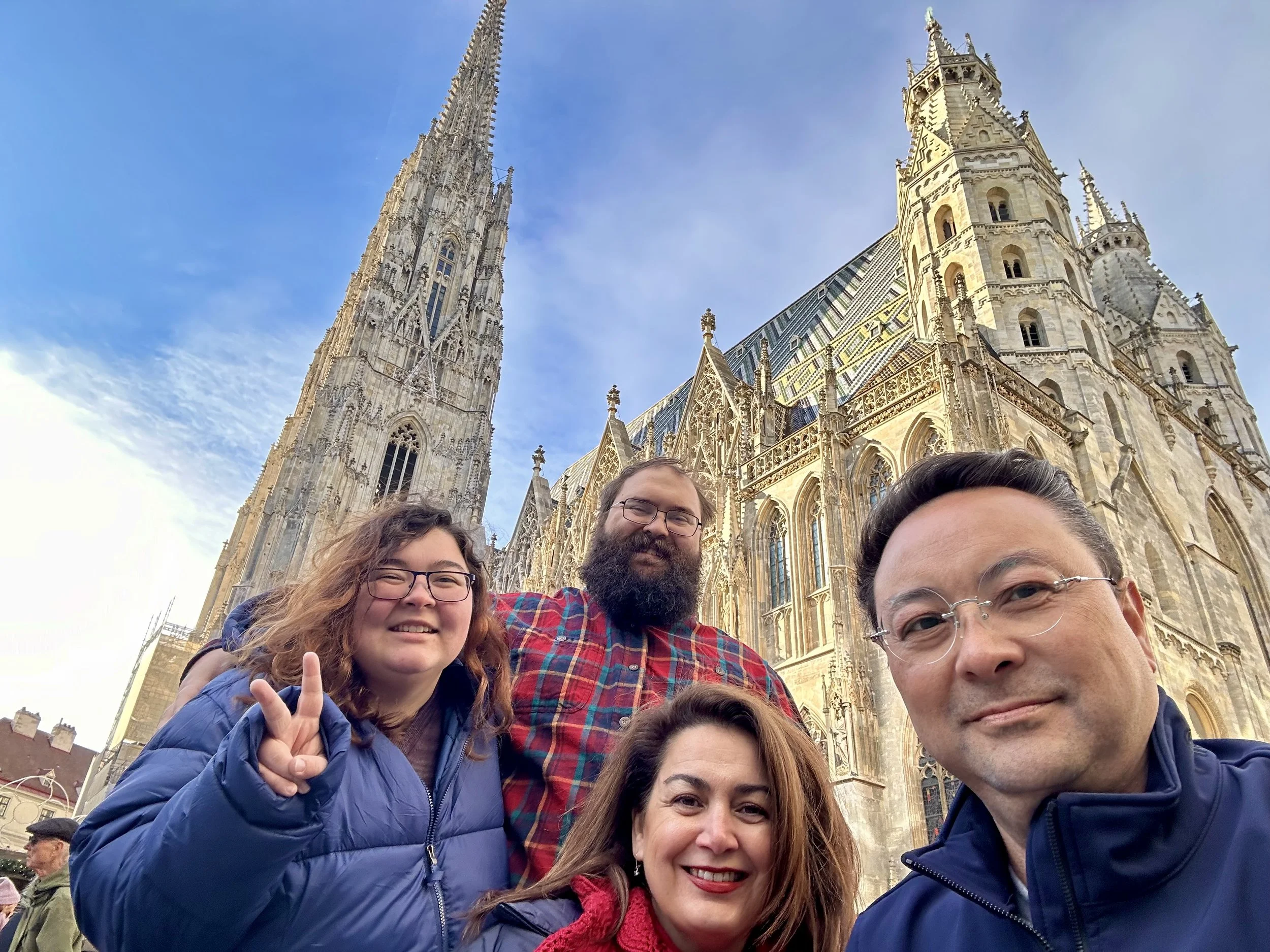
That roof is around a quarter million glazed tiles and the south tower took 65 years to build. We gave it about 20 minutes and a selfie.
Vienna in December is an argument the city wins before you even unpack.
We stepped off the plane and into the Innere Stadt, Vienna's First District and a UNESCO World Heritage Site, and within an hour we were at a wooden cart with a bratwurst in a crusty roll, breath fogging in the cold, the cobblestones glowing with market lights. If you have ever worried that the European Christmas market has been commercialized past the point of meaning anything, Vienna is the rebuttal. The city has held December markets since at least 1298, when Duke Albrecht I granted the right to one, which makes its claim to the whole idea about as old as it gets. Some cities put on a market. Vienna runs seven, and after years of markets across Germany and central Europe, it is arguably the best of them.
But Vienna rewards a visit in any season, and we have made the trip three times. What it offers is rarer than a good market: an intact imperial center you can walk end to end without a car or a plan, almost entirely flat and almost entirely pedestrianized.
You feel the imperial part before you know any of it. For something like six centuries this was the seat of the Habsburgs, and the architecture is the receipt. The first time through, we kept stopping in the middle of squares just to look up. The Hofburg, the palace at the heart of the old city, grew over those centuries as each ruler added a wing in the style of the day, so the whole thing reads like a timeline you walk through rather than read about. The squares are wide and the facades grand on purpose, built by a city that thought of itself as the center of Europe and, for a good long stretch, was not wrong.
December is when we recommend going, so this article starts there. But Vienna is not only a winter destination.
The Hotels
Park Hyatt Vienna: The hotel sits on Am Hof, one of the oldest squares in the Innere Stadt, which in December puts it directly beside the Advent am Hof market. On our first night we walked out the front door and into it. The building opened in 1915 as a bank in the grand style of the late Austro-Hungarian era, and the architects kept all of it: marble columns and vaulted ceilings, with ironwork meant to impress clients who arrived carrying serious money. The Bank restaurant occupies the old main hall, and the Arany Spa sits below ground in what were the vaults. Whether turning a bank vault into a lap pool reads as clever or a little on the nose, the execution is hard to argue with.
Book This: A room over Am Hof. The square is one of Vienna's most beautiful, and the December market lights turn it into something you will not want to close the curtains on.
Accessibility: The main entrance has several steps and is not step-free. Ask the doorman, who will direct you around to a step-free side entrance through a gate that opens into the lobby and the rest of the hotel.
Rosewood Vienna: One of the newest of the grand hotels in the old center, and the location was perfect. It sits in a former bank on Petersplatz, in a building that also holds the apartment where Mozart once lived, the kind of thing Vienna mentions to you almost in passing. Where the Park Hyatt leans into its history, the Rosewood is brighter and more art-forward. We loved it most for where it puts you: Stephansdom three minutes on foot, the Graben two, the nearest market stand about one.
Book This: A room with a Petersplatz view. The baroque facade of Peterskirche fills the window and is best after dark.
Accessibility: Step-free from street level, with the surrounding pedestrian streets flat and easy to navigate.
Mandarin Oriental, Vienna: The hotel opened in October 2025 on Riemergasse, a quiet street in the old core, in a heritage-listed Art Nouveau building that began as a courthouse in 1908. That makes a pattern with the two above: a bank, a bank, and now a courthouse, all reborn as places to sleep. We have not stayed yet, so we will not pretend to review it. What we will say is that we are long-time loyalists of the brand, which does not open a hotel that falls short of its own standard. The location is almost as strong as the Park Hyatt and the Rosewood, a few minutes further from the center but still an easy walk to everything. It is at the top of our list for the next trip.
Hotel Sacher Wien: The Sacher we also cannot speak to firsthand, so take this as reputation rather than verdict. It is the most storied hotel in Vienna, family-owned since 1876, sitting directly behind the State Opera, and home of the original Sacher torte and the wood-paneled Café Sacher. Everyone we trust who has stayed speaks well of it, and it carries an old-Vienna reputation the newer houses cannot manufacture. If your idea of Vienna runs to the grande-dame tradition rather than the contemporary, the Sacher is the address history points to, and one we intend to book ourselves.
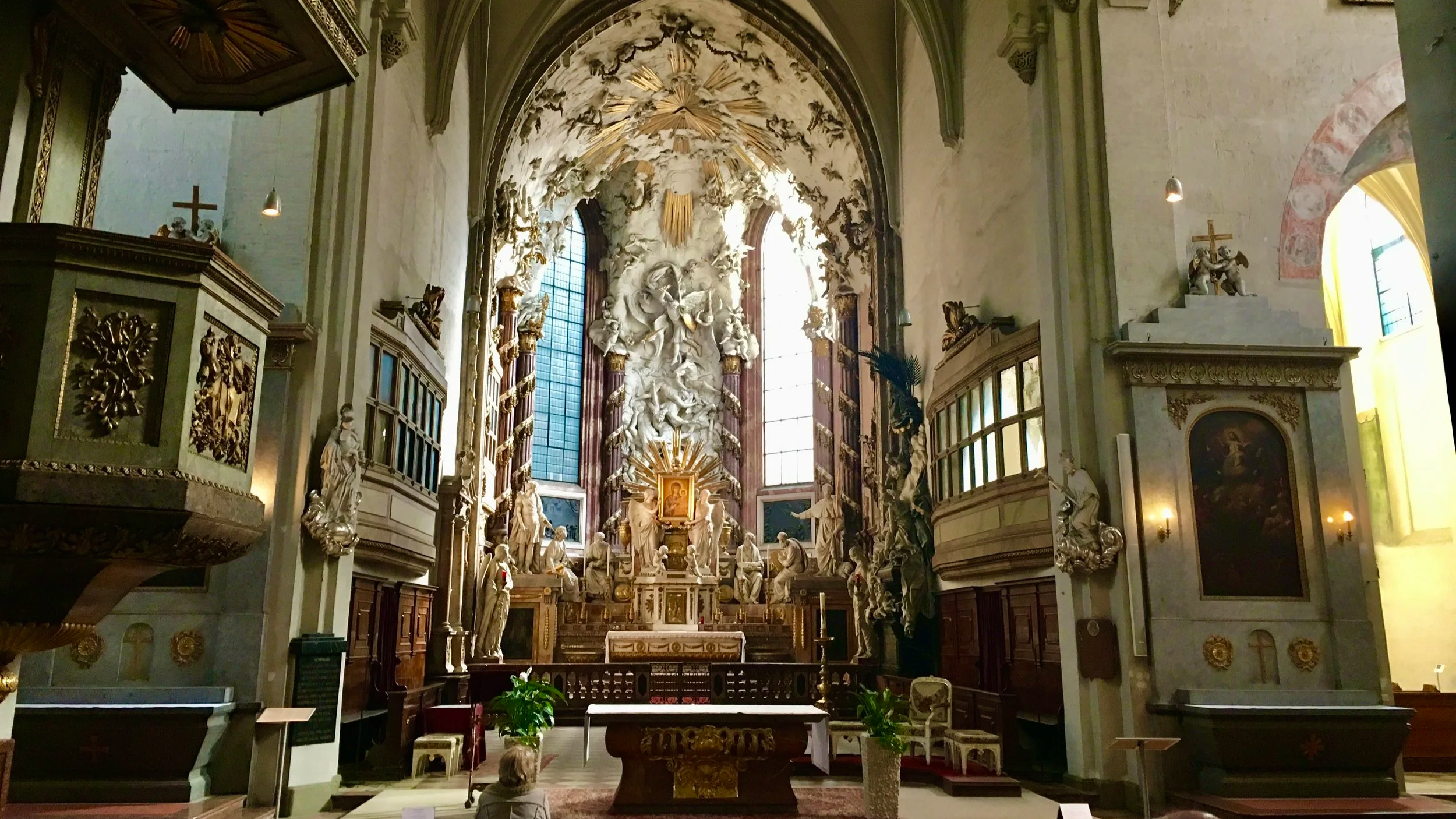
Two minutes off the main square, this is what you get. We had it almost to ourselves.
The Dining Scene
Café Central: This is the grand Viennese coffeehouse you picture in your head, and it lives up to it. We came for the Melange, the local take on a cappuccino, and a slice of apple strudel, and ended up staying far longer than we meant to. The room does that. The arches climb overhead, and a wax figure of an old regular, a poet who all but lived here, watches from near the door. You sit there feeling like you have wandered into the city's living room, and we left thinking most cafés feel a little provisional by comparison.
Order This: Melange with Apfelstrudel.
The Bank Brasserie and Bar: Inside the Park Hyatt, in the old banking hall described above, this is worth a stop whether or not you are staying there. The food holds its own against the setting, with well-executed brasserie classics and a bar that ranks among the best in the city. It pulls a local crowd rather than only hotel guests, which is usually the sign a hotel restaurant is doing something right.
Order This: A cocktail before dinner, even if you are eating elsewhere. The room does most of the work.
Demel: Demel has been making pastry on Kohlmarkt for well over two centuries, back to when it baked for the imperial court, and it is one half of the city's longest-running feud. It and the Hotel Sacher spent decades fighting over which one makes the real Sachertorte, a quarrel that turned in part on whether the original has one layer of sponge or two. Order a slice at each across your trip and pick a side. The room is the other reason to come, dark wood and mirrors with a window onto the bakery, and waitresses who still address you in a formal third person that takes a second to decode.
Order This: A slice of the Sachertorte, so you have grounds for an opinion. The candied violets were a favorite of Empress Elisabeth and travel home well.
Figlmüller: The schnitzel place everyone tells you about, and we showed up skeptical the way you do about anything that famous. We left converted. The Wiener Schnitzel here is pork, pounded thin and fried golden until it overhangs the plate on both sides. It is not subtle, and it is not trying to be. The room is small and packed, which told us most of what we needed to know before the food even landed. Book ahead.
Order This: The Wiener Schnitzel with potato salad.
Zum Schwarzen Kameel: Around the corner from the Park Hyatt, on Bognergasse, is a place trading since 1618. Zum Schwarzen Kameel, the Black Camel, began as a spice shop and grew into a fixture the city's old families have leaned on for generations, and Beethoven was a regular long before the Art Nouveau room you sit in today existed. What we loved most was coming in just for dessert, a slice from the patisserie case up front, where Josef Hoffmann's black display cabinet holds Esterházy torte and fruit dipped in chocolate. Sitting near that case with a coffee and a cake for an hour is a small ritual we would happily build a morning around.
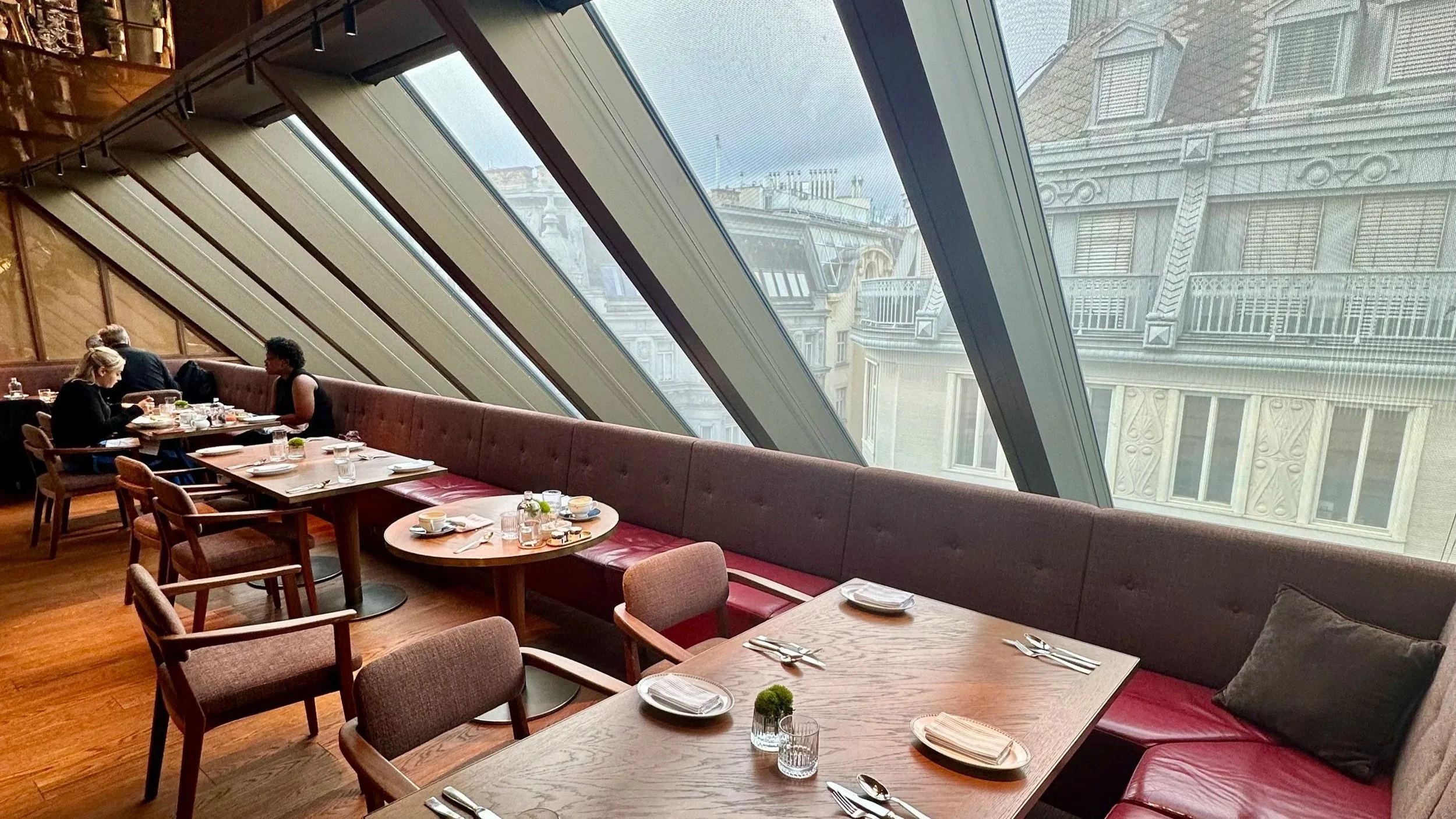
Some mornings you eat to keep moving. This was a morning to sit still and look out.
What to See
Vienna's Christmas markets run from mid-November through December 24, and we visited three, each a different idea of what a market is for.
Rathausplatz: The biggest and the most theatrical, set in front of the floodlit City Hall, which at night had us wondering what the building even looks like the rest of the year without the lights. It is the one the city puts on its postcards and the one most people see first, and we think it earns the crowds.
Advent am Hof: Smaller and quieter, and the one we kept drifting back to. It fills the square where, we later learned, the Holy Roman Empire was formally wound up, which gives the whole scene a grander backdrop than a Christmas market strictly needs. More handmade goods and fewer crowds, and an easy stroll from the Park Hyatt.
Spittelberg: The one the locals kept pointing us toward, a twenty-minute walk out into a neighborhood of narrow cobblestone lanes and old row houses. The goods are handmade and the crowds thin out, and the ratio of Glühwein to everything else is exactly right. We would tell you to make it a destination on its own rather than an afterthought.
Don't Miss: The Glühwein comes in a ceramic mug with a deposit. Keep the mug.
Accessibility: Rathausplatz and Advent am Hof are flat and step-free. Spittelberg's cobblestone lanes are charming but uneven, worth noting for wheelchair users and anyone with limited mobility.
Stephansdom: St. Stephen's sits dead center, the point the whole city seems to arrange itself around, and we passed it a dozen times a day without ever quite getting used to it. What stayed with us is that the cathedral is not entirely the original. In the last days of the war it caught fire and the medieval roof collapsed, and Vienna rebuilt it afterward, laying the roof back in its bright zigzag of tiles. We liked it more for knowing that, a church the city chose to put back together rather than replace. Inside, the nave is vast and dark in the way that makes the light through the windows land.
Don't Miss: The roof tiles from street level. The pattern is extraordinary and visible from almost anywhere around the cathedral.
Accessibility: The interior is step-free at the main entrance, and the north tower has an elevator. The south tower is 343 steps with no elevator.
The Hofburg and the Spanish Riding School: This is the palace we mentioned earlier, the one that grew a wing per ruler, and it sits a few minutes from both the Park Hyatt and the Rosewood. We spent an afternoon just wandering the courtyards and Heldenplatz, which is free and badly underrated, the architecture doing all the work without your having to buy a ticket to anything. The sheer scale tells you most of what you need to know about what this city used to be. The Hofburg is also home to the Spanish Riding School, where the white Lipizzaner stallions still perform their slow, precise dressage in a baroque hall built for exactly that.
Don't Miss: The courtyards and Heldenplatz, free to walk, with the architecture as the whole point. And the Lipizzaners if the schedule allows, where the morning exercise is a quieter and cheaper way to see the horses work than the gala. Tickets to either sell out, so book ahead.
Accessibility: Heldenplatz and the main courtyards are flat and step-free. For the Spanish Riding School, contact them ahead about seating and access, since the historic hall has its own constraints.
Schönbrunn Palace: The Habsburgs' summer place, a little way out from the center. We will be straight with you: we arrived too late in the day to tour the rooms, so we cannot tell you what the inside is like. What we can tell you is that it did not matter as much as we expected. The exterior is staggering on its own, a butter-yellow facade that runs on and on, and the grounds were enough to make the trip out worth it. We walked the gardens with the light going gold behind the palace, and that picture has stuck with us more than most interiors we have actually paid to see. Go earlier than we did if you want the state rooms.
Accessibility: The main palace floor is reached by elevator, and the gardens near the building are largely flat. The hill to the Gloriette is a steep climb with no elevator. The courtyard market is flat and step-free.
Beyond Vienna
The Ringstrasse: The grand boulevard that rings the old town is technically still Vienna but feels like a different city, a showpiece avenue the emperor laid out in the 1800s and lined with the big set pieces, the State Opera, the Kunsthistorisches Museum, Parliament, the City Hall. Tram line 1 runs the loop for the price of a single ticket, and it is the great orientation a first-time visitor.
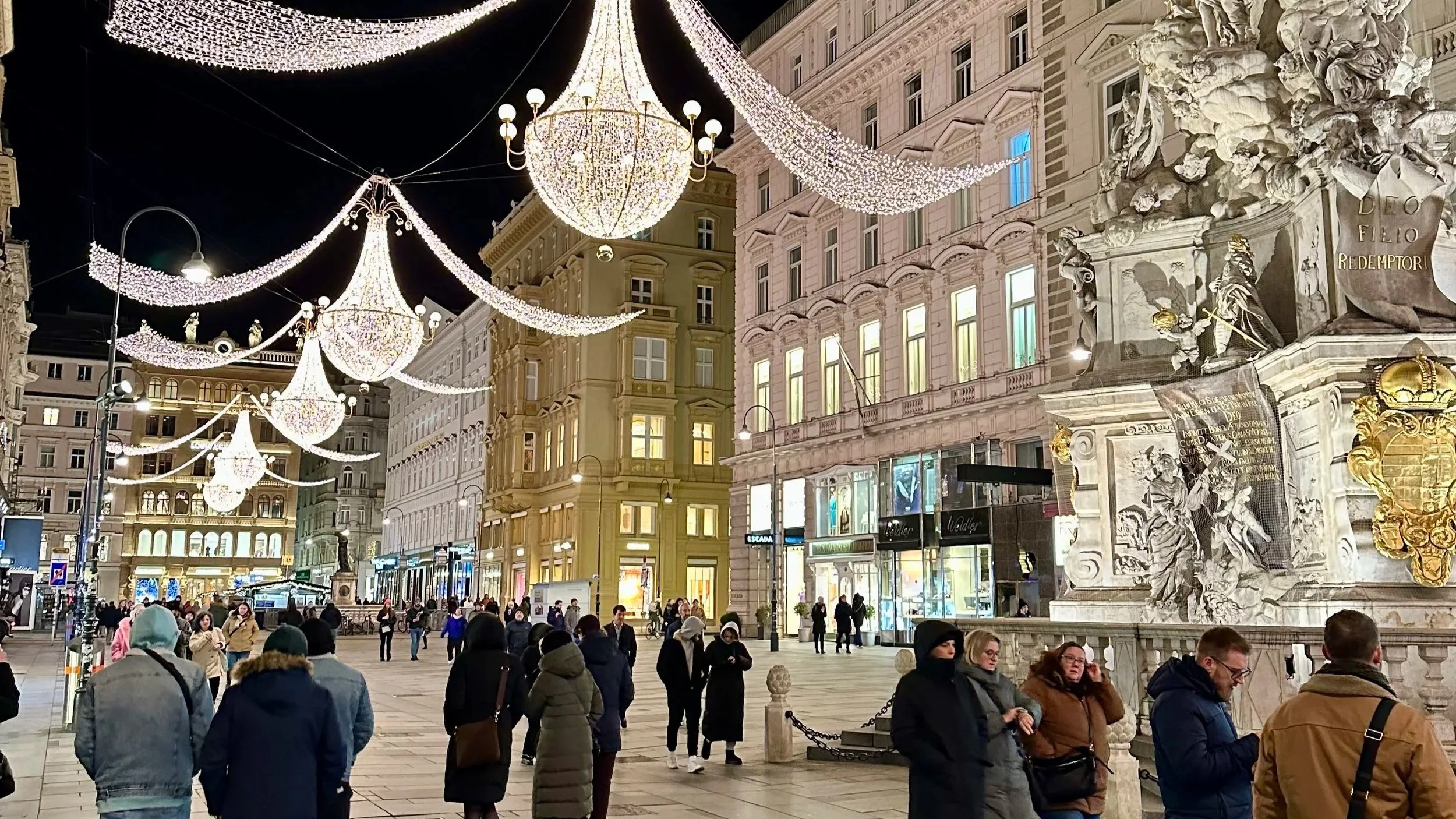
No cars and no curbs. The Graben is flat and pedestrian the whole way, which is rarer in a historic old center than it should be.
What Stayed with Us
What stayed with us is not any single sight. It is how close the ancient and the ordinary sit to each other here. Vienna does not rope off its history or explain it. A cathedral that has stood for centuries is just the thing you walk past on the way to dinner. A baroque column raised after a 17th-century plague stands in the middle of a shopping street, and the shoppers cut around it without a glance. None of it is presented to you. It is simply there, part of a regular afternoon, and the city goes about its day as if that were unremarkable.
That is the part we carry home. Not the monuments themselves, but how matter-of-fact Vienna is about living among them.
Our Favorite Discovery: The Late-Night Würstelstand
The Würstelstand is the small bratwurst cart you find on street corners all over Vienna, and the one near Stephansdom around 10pm gave us the best thing we ate all trip. We had spent two hours at the Rathausplatz market, finished our Glühwein, and were not ready for the evening to end or for a full dinner. We ordered a Käsekrainer, a pork sausage filled with cheese that bubbles through the casing as it cooks, tucked into a crusty semmel roll with mustard, and ate it standing on the cold cobblestones. Delicious.
Accessibility
The thing we find most refreshing about Vienna is the one most travelers never think about. The historic center of almost any old city is its least accessible part. The streets are the oldest in the city and the buildings are protected, so the modifications that would make them work for a wheelchair are difficult and often impossible. That is the rule nearly everywhere we go. Vienna breaks it. The Innere Stadt is close to flat and largely car-free through the core pedestrian zones of Kärntner Strasse, Graben, and Kohlmarkt, so the most historic part of the city turns out to be the easiest to move through. It is one of our favorite cities anywhere for accessibility, and that is not a sentence we get to write often.
The specifics hold up. The main markets at Rathausplatz and Advent am Hof are step-free, as are the Hofburg courtyards and Heldenplatz. Stephansdom has a step-free main entrance and a north tower elevator. Schönbrunn has elevator access to the main floor, though the hill to the Gloriette has no accessible alternative, and the Spittelberg market means uneven cobblestone. The U-Bahn reaches every station step-free, an elevator or ramp at each one, so you can cross the whole city underground without a stair in the way. Elevators go down for service now and then, worth checking on the day, but the network is built for this.
For a traveler using a wheelchair or a mobility aid, the part of Vienna you most want to see is also the part that asks the least of you.
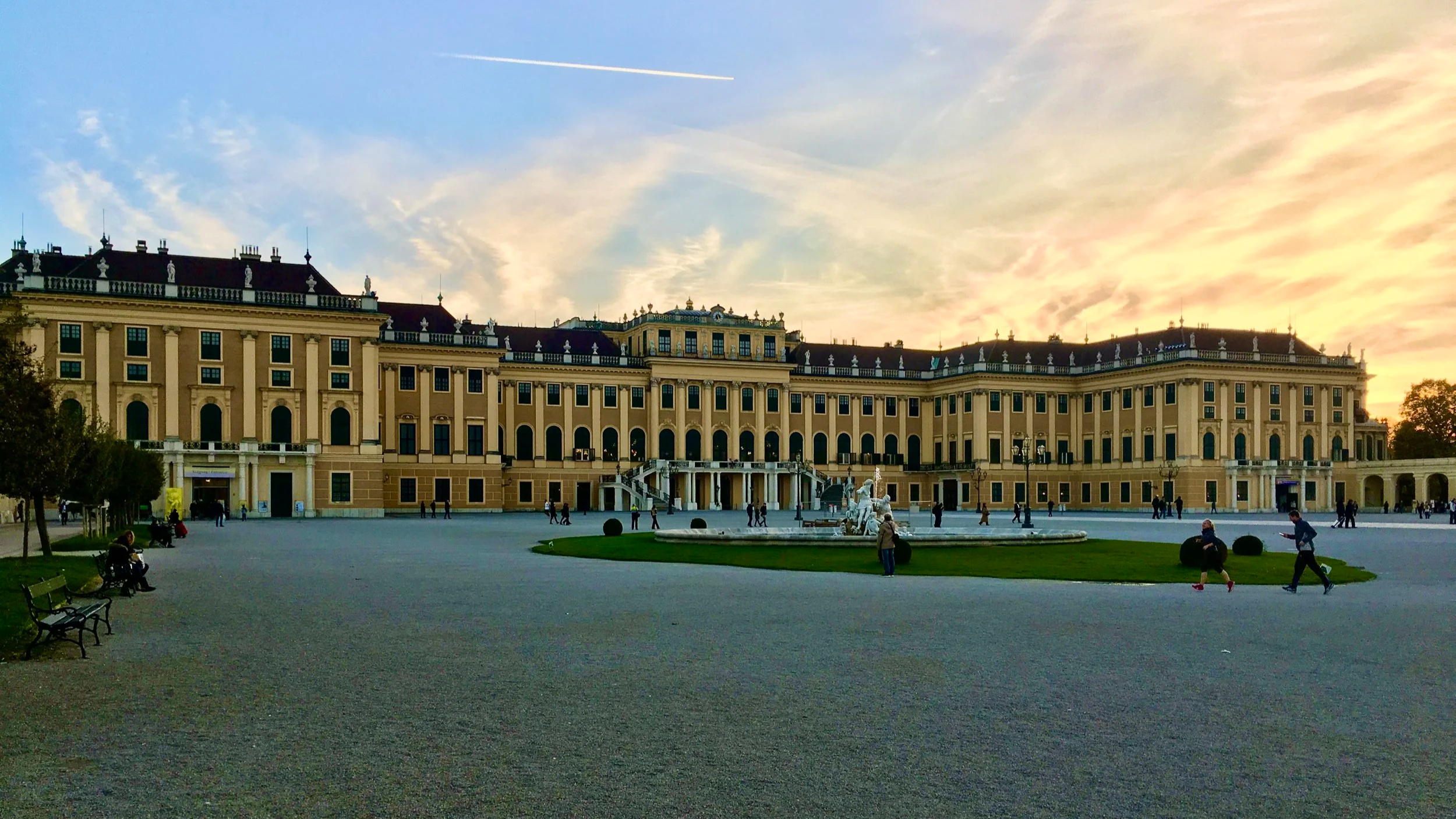
Come at the end of the day, when the tour buses thin out and the light does this. Fewer people, better photos.
The TudorTravels Perspective
The pull of Vienna is harder to pin to a single sight or meal. We just love being there. Standing in the middle of all that grand architecture, with nowhere you urgently have to be, is its own reason to come. There is a steadiness to the place, a sense that it has been doing exactly this for centuries and is in no hurry to change, and you feel it the moment you slow to its pace. In December the Christmas markets take that feeling over the top.
What makes it work day to day is how little the city asks of you. Almost everything you want to see or eat sits within walking distance, and so do several of the markets, so a full day rarely calls for a taxi. It is a small thing that changes the whole texture of a trip. The local markets like Spittelberg turn out to be as interesting as the famous ones at Rathausplatz, sometimes more, and far quieter for it. And the hotels fit the city rather than fight it, putting you inside a former bank or courthouse without asking you to give up a modern bed or a good shower.
If December does not work, winter has a second act. From January into February the city turns to its ball season, more than 450 balls, with the Opera Ball at the State Opera as the centerpiece, the night the opera house becomes a ballroom and the whole country tunes in.
Vienna is not cheap, but it is cheaper than Paris or London, and for our money it beats both on atmosphere. You are paying for a setting that earns the price, in the season when the city is at its best.
We have been three times. We are already planning a fourth.
Inspired by Vienna? Contact us to plan your time there, or anywhere else in Europe you want to explore.